CUETMOCK
  • Pricing
  • Mentors
Log inStart freeStart free mocks→

First test, then trust

Try a free CUET mock test.

Join 5,00,000+ students who rehearsed exam day on the exact NTA screen before sitting CUET. On the web and on Android.

Start free mocks →Get the Android app
CUETMOCK

India's #1 CUET Mock Test Platform. Original NCERT-based questions on the exact NTA exam screen — trusted by 5,00,000+ students since CUET 2022.

Get it onGoogle PlayScan to download the CUETMOCK app

Mock tests

  • CUET mock test series
  • Commerce mocks
  • Humanities (Arts) mocks
  • Science mocks
  • Languages & GAT mocks
  • Free practice questions
  • Pricing

Resources

  • CUET exam guide
  • CUET syllabus
  • Universities accepting CUET
  • Expert blogs
  • News & notifications
  • Webinars & counselling
  • CUET score calculator
  • How we estimate your rank
  • FAQs

Company

  • About us
  • Our leadership & team
  • Our toppers
  • Mentors
  • For schools
  • Contact us
  • Terms
  • Privacy
  • Refund policy

Talk to us

+91 7696 6630 56info@cuetmock.comWhatsApp us

Our other platforms

  • JEE Mock — For IIT-JEE aspirants
  • NEET Mock — For NEET aspirants

Newsletter

Exam updates, study material and offers — no spam.

© 2026 NYC Ventures Pvt. Ltd.

701-702, Royal Business Park, Zirakpur, Punjab - 140603

  • Terms of use
  • Privacy policy
  • Refund policy
  • Contact us

iCUETMOCK is an independent preparation platform, not affiliated with the National Testing Agency (NTA). Always check exam details on the official NTA website.

  • Home
  • Mock tests
  • CUET guide
  • Pricing
  • Log in
Home/Practice questions/History
HistoryAncient India: Bricks, Beads and Bones

In some Harappan seals, a figure seated cross-legged in a “yogic” pos…

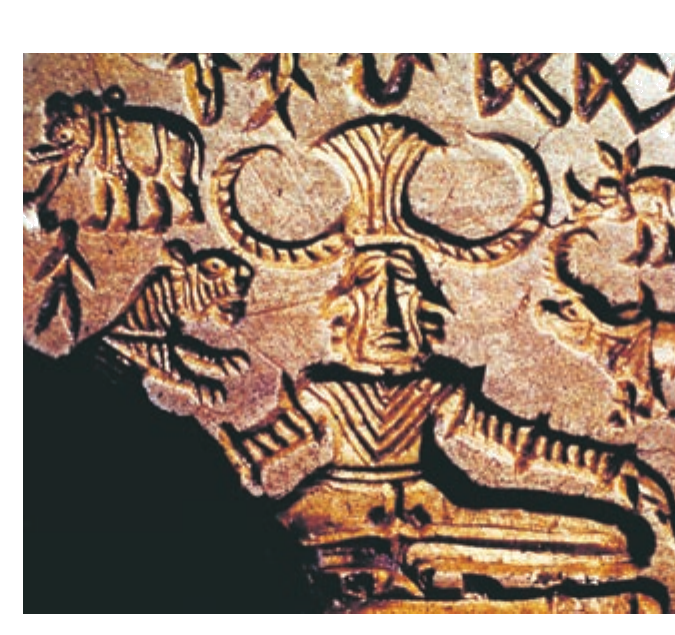
In some Harappan seals, a figure seated cross-legged in a “yogic” posture, is regarded as a depiction of which deity?

Answer & explanation+

Correct answer: option 3

The correct answer is Option (3) → Proto-Shiva

Archaeologists have tried to reconstruct Harappan religion from the seals. On some seals a figure sits cross-legged in a “yogic” posture, sometimes surrounded by animals, and it has been regarded as a depiction of “proto-Shiva”, that is, an early form of one of the major deities of Hinduism. The identification is not certain: Rudra, the Rigvedic name later used for Shiva, is described neither as lord of animals nor as a yogi, and some scholars think the figure may be a shaman.

Note: A same/similar question was asked in CUET (UG) in the papers below.

20262025202420232022
20-05 S103-06 S2*–––

* A similar question.


NCERT (2025-26): “11.2 Problems of interpretation … Attempts have also been made to reconstruct religious beliefs and practices by examining seals, some of which seem to depict ritual scenes. Others, with plant motifs, are thought to indicate nature worship. Some animals – such as the one-horned animal, often called the ‘unicorn’ – depicted on seals seem to be mythical, composite creatures. In some seals, a figure shown seated cross-legged in a ‘yogic’ posture, sometimes surrounded by animals, has been regarded as a depiction of ‘proto-Shiva’, that is, an early form of one of the major deities of Hinduism.… Let us look, for instance, at the ‘proto-Shiva’ seals. The earliest religious text, the Rigveda (compiled c. 1500-1000 BCE) mentions a god named Rudra, which is a name used for Shiva in later Puranic traditions (in the first millennium CE; see also Chapter 4). However, unlike Shiva, Rudra in the Rigveda is neither depicted as Pashupati (lord of animals in general and cattle in particular), nor as a yogi. In other words, this depiction does not match the description of Rudra in the Rigveda. Is this, then, possibly a shaman as some scholars have suggested?…”

NCERT extract

Fig. 1.27 A “proto-Shiva” seal

Advertisement

Practise more on Ancient India: Bricks, Beads and Bones

Chapter-wise mocks on the real NTA exam screen, with solutions and your rank. Your first mocks are free.

Start free mocks →

Advertisement

Next questions

  1. Who moved the crucial “Objectives Resolution”?History · Modern India: Framing the Constitution
  2. A man with a normal near point (25 cm) reads a book with small print using a magnifying glass of focal length 5 cm. The closest distance at…Physics · Ray Optics
  3. Which among the following is not a ground for justification of India’s nuclear tests in 1998?Political Science · Contemporary World Politics: Contemporary Centres of power
  4. Match List-I with List-IIList-IList-IIPlacental mammalsAustralian marsupials(A) Anteater(I) Bandicoot(B) Lemur(II) Spotted cuscus(C) Flying…Biology · Evolution
  5. Four friends, namely S, R, T and V are all sitting in a straight row, facing the same side. Further, it is known that T and V have no one s…General Aptitude Test · Verbal Reasoning
  6. Five cells, each of emf (E) and internal resistance (r), are connected in series. If out of these five cells, one of the cells is connected…Physics · Current Electricity
  7. The value of ∫_0^1x e^x^2 dx is equal to :Applied Maths. Section A · Definite Integration (Section A)
  8. Match the LIST-I with LIST-IILIST-ILIST-II(Instruments of money market)(Explanation)A. Treasury BillI. Unsecured, negotiable, short term in…Business Studies · Financial Markets
  9. Fill in the blank with the appropriate word from the given options:Despite an affected_______that convinced casual observers that he was in…English · Fill Blanks
  10. Match List-I with List-IIList-I(Political events)List-II(Year)(A)Congress gave the slogan of Garibi Hatao in elections(I)1974(B)Students pr…Political Science · Politics in India Since Independence: Crisis of democratic Order