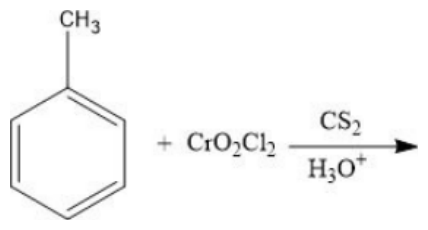
Identify final product of the following reaction
Answer & explanation
Correct answer: option 1
The correct answer is Option (1) → benzaldehyde.
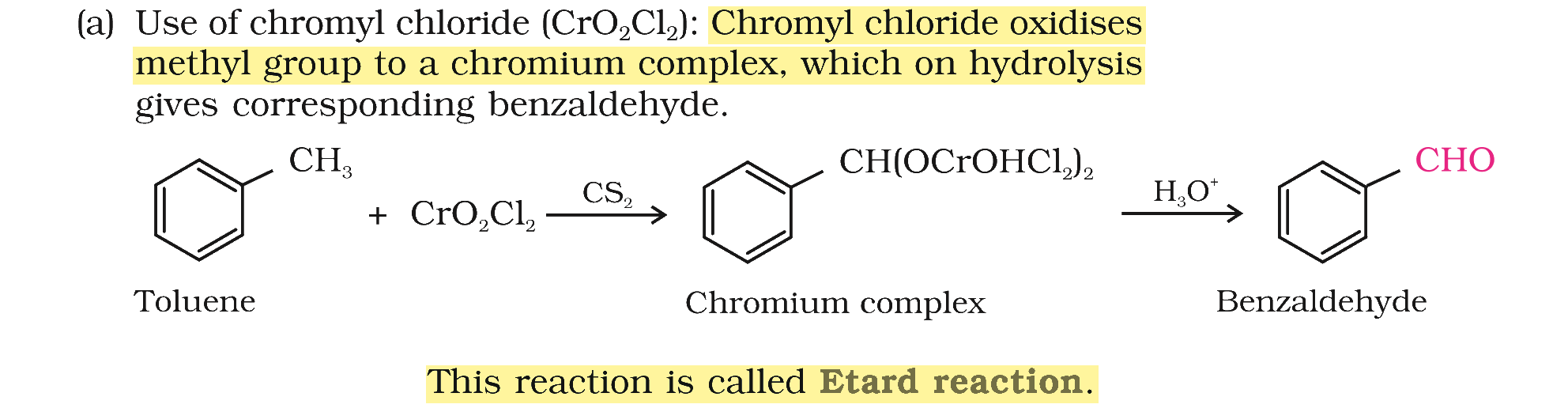
Strong oxidising agents such as \( \ce{KMnO4} \) oxidise the methyl group of toluene all the way to –COOH. To stop at the aldehyde stage, chromyl chloride (CrO2Cl2) is used in \( \ce{CS2} \). It oxidises the methyl group to a chromium complex, which on hydrolysis gives the aldehyde. This is the Étard reaction:
\( \displaystyle \ce{C6H5CH3} \xrightarrow{\ce{CrO2Cl2}/\ce{CS2}} \ce{C6H5CH(OCrOHCl2)2} \xrightarrow{\ce{H3O^+}} \ce{C6H5CHO} \)
Only the side chain is attacked; the ring is not touched. So the final product is benzaldehyde.
Why the other options are incorrect
Option (2) 4-methylbenzaldehyde — Incorrect. This would need a new –CHO group on the ring with the methyl group left unchanged; in the Étard reaction the methyl group itself becomes –CHO.
Option (3) 4-chlorotoluene — Incorrect. Ring chlorination needs \( \ce{Cl2} \) with a Lewis acid (\( \ce{FeCl3} \)); chromyl chloride acts as an oxidising agent here, not a chlorinating agent. Ring chlorination of toluene gives a mixture of 2- and 4-chlorotoluene:
\( \displaystyle \ce{C6H5CH3 + Cl2} \xrightarrow{\ce{FeCl3}} \ce{ClC6H4CH3 + HCl} \)
Option (4) 2-chlorotoluene — Incorrect. Ring chlorination with \( \ce{Cl2} \)/\( \ce{FeCl3} \) would give this ortho product along with the para one, but chromyl chloride does not chlorinate the ring.
NCERT (2026-27 edition):
Use of Chromyl Chloride (CrO2Cl2)