Suppose Prachi buys 30 bananas when its price is Rs. 10 per banana. When the price increases to Rs. 14 per banana, she reduces her demand to 24 bananas. What is the price elasticity of demand in absolute terms?
Answer & explanation
Correct answer: option 1
The correct answer is Option (1) → 0.5
When the price of a good rises, people buy less of it. The price elasticity of demand measures how strongly they react: it is the percentage change in quantity demanded divided by the percentage change in price.
Given:
Old price, P1 = Rs. 10; new price, P2 = Rs. 14
Old quantity, Q1 = 30 bananas; new quantity, Q2 = 24 bananas
The formula:
eD = (percentage change in quantity demanded) ÷ (percentage change in price)
The two percentage changes:
Percentage change in quantity = (24 − 30) ÷ 30 × 100 = −20
Percentage change in price = (14 − 10) ÷ 10 × 100 = 40
The elasticity:
eD = −20 ÷ 40 = −0.5
The sign is negative because demand falls when price rises; in absolute terms the elasticity is 0.5.
Since 0.5 is less than 1, the demand for bananas here is inelastic: a 40 per cent rise in price cuts the quantity bought by only 20 per cent.
In absolute terms, |eD| = 0.5, which is Option (1).
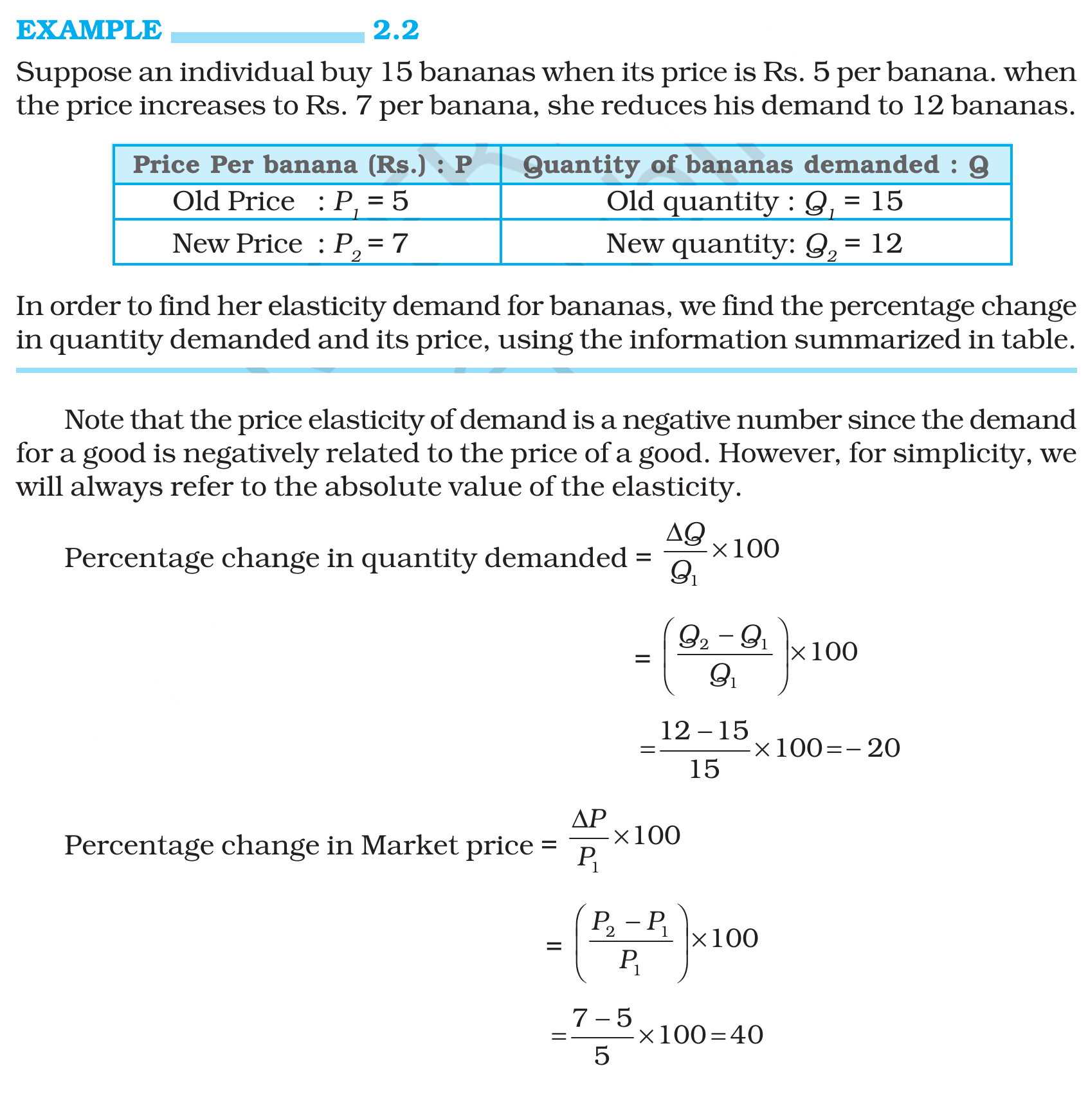
Note 1: This question is the NCERT book’s own Example 2.2 with the figures doubled: the book has 15 and 12 bananas at Rs. 5 and Rs. 7 per banana. The percentage changes, 20 and 40, and the answer, 0.5, are the same as in the book.
Note 2: A same/similar question was asked in CUET (UG) in the papers below.
| 2026 | 2025 | 2024 | 2023 | 2022 |
| 13-05 S1 | 13-05 S1* | – | – | – |
* A similar question.
NCERT: Introductory Microeconomics — Chapter 2: Theory of Consumer Behaviour, Example 2.2 (2025-26)
|