Comprehension:
Solutions
The solution which obeys Raoult's law over the entire range of concentration are known as ideal solutions and which does not obey are known as non-ideal solution. The vapour pressure of a non ideal solution is either higher or lower than that predicted by Raoult's law equation. The colligative properties, which depend on the number of solute particles irrespective of their nature, are relative lowering of vapour pressure, depression of freezing point, elevation of boiling point and osmotic pressure. All these properties can be utilised for the determination of molar mass of the solute.
Which of the following expressions for relative lowering of vapour pressure of a solution is incorrect?
Answer & explanation
Correct answer: option 3
The correct answer is Option (3) → \( \displaystyle \frac{\Delta p_1}{p_1^0}=\frac{n_1}{n_2} \)
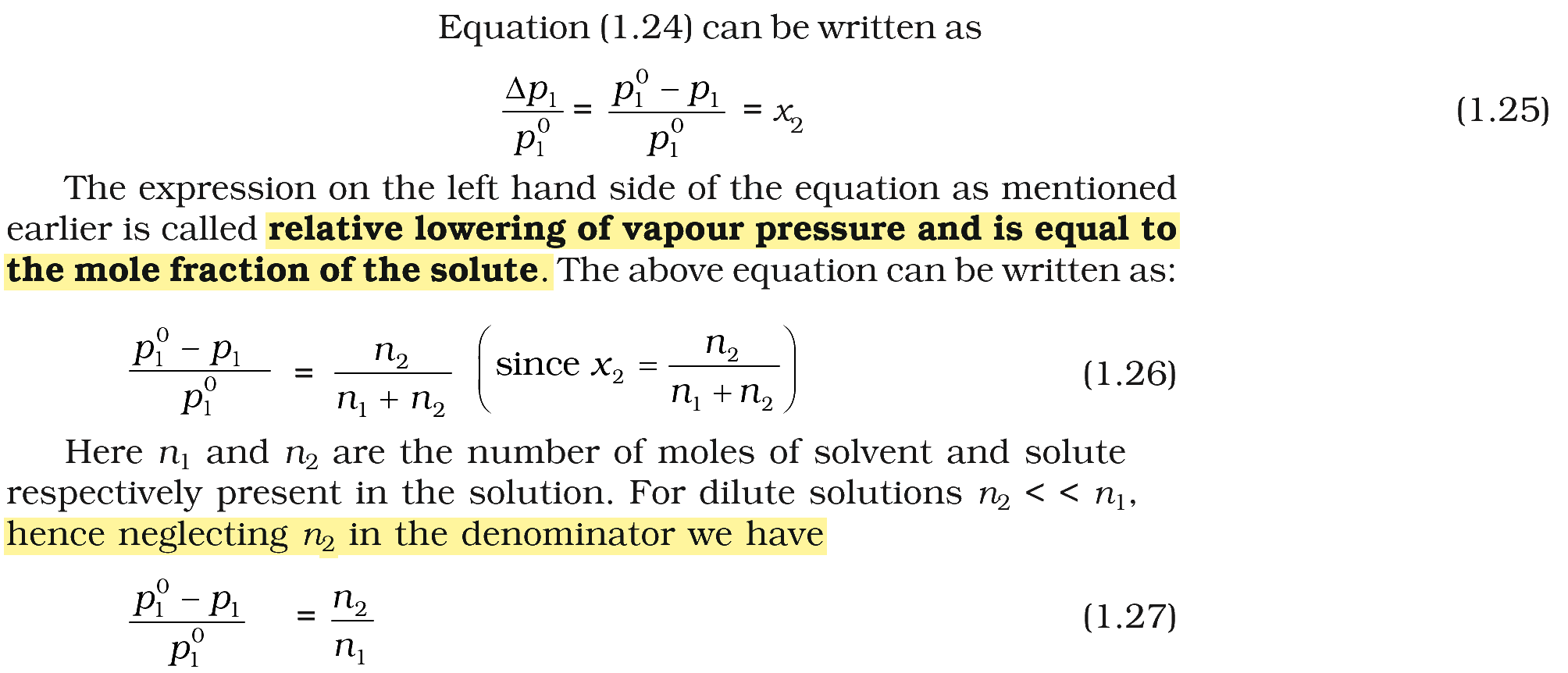
For a dilute solution the relative lowering equals n2/n1, which in terms of masses is:
\( \displaystyle \frac{n_2}{n_1}=\frac{w_2\,M_1}{M_2\,w_1} \)
Option (1) \( \displaystyle \frac{\Delta p_1}{p_1^0}=x_2 \) — A correct expression. The relative lowering equals the mole fraction of the solute.
Option (2) \( \displaystyle \frac{p_1^0-p_1}{p_1^0}=x_2 \) — A correct expression. It is the same relation, with Δp1 written out as p10 − p1.
Option (3) \( \displaystyle \frac{\Delta p_1}{p_1^0}=\frac{n_1}{n_2} \) — The incorrect expression. The ratio is inverted; for a dilute solution it is n2/n1.
Option (4) \( \displaystyle \frac{p_1^0-p_1}{p_1^0}=\frac{w_2\,M_1}{M_2\,w_1} \) — A correct expression. It is the dilute-solution form obtained from n2/n1, used to find the molar mass M2.
NCERT (2026-27 edition):
Relative Lowering of Vapour Pressure – …