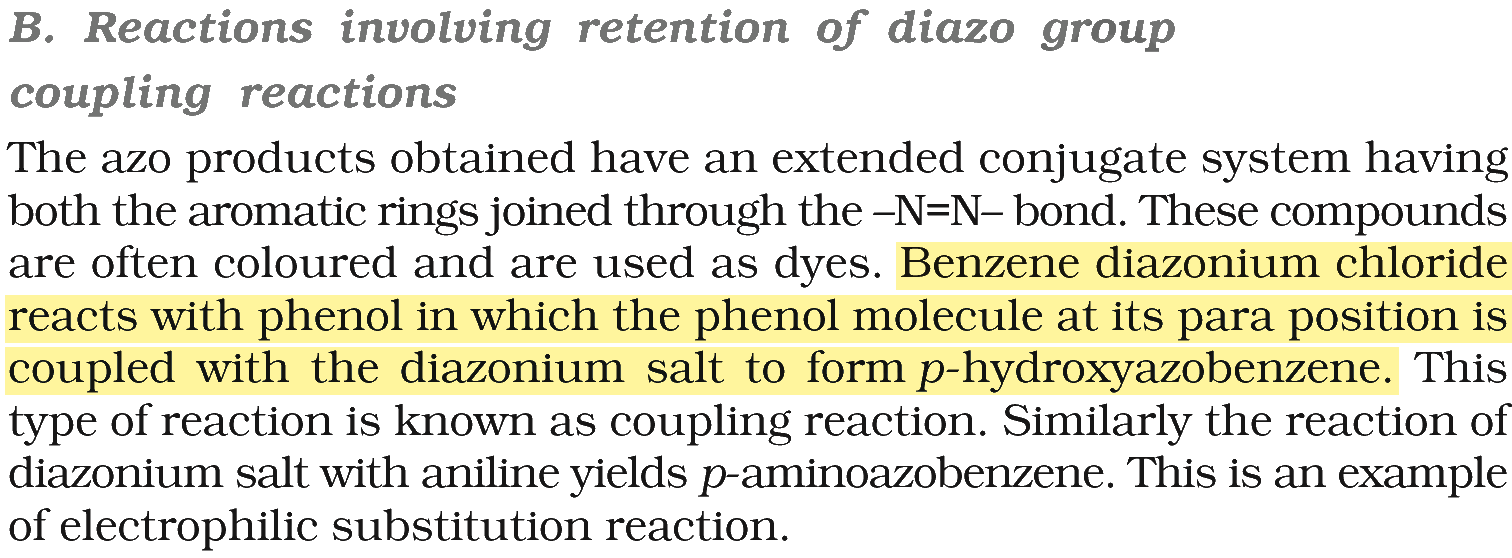
Benzenediazonium chloride reacts with phenol in the presence of NaOH to form
Answer & explanation
Correct answer: option 4
The correct answer is Option (4) → p-hydroxyazobenzene
The benzenediazonium ion, \( \ce{C6H5N2^{+}} \), is a weak electrophile. It attacks strongly activated aromatic rings such as phenols and anilines in an electrophilic substitution called a coupling reaction. The two rings become joined through an –N=N– (azo) group, and the products are brightly coloured azo dyes.
With phenol, the reaction is carried out in mildly alkaline medium (NaOH). This converts phenol into the phenoxide ion, which activates the ring even more. The diazonium ion attacks the para position, as the ortho positions are more hindered:
\( \displaystyle \ce{C6H5N2^+Cl^- + C6H5OH} \xrightarrow{\ce{OH^-}} \ce{C6H5-N=N-C6H4-OH + Cl^- + H2O} \)
The product is p-hydroxyazobenzene, an orange dye.
Why the other options are incorrect
Option (1) p-aminoazobenzene — Incorrect. This yellow dye forms when benzenediazonium chloride couples with aniline (in mildly acidic medium), not with phenol.
Option (2) p, p′-dihydroxyazobenzene — Incorrect. The diazonium salt brings a plain phenyl group; only the phenol ring carries OH, so the product has just one OH group.
Option (3) o-hydroxyazobenzene — Incorrect. Coupling takes place mainly at the para position; the ortho product is formed only when the para position is blocked.
NCERT (2026-27 edition):
Reactions Involving Retention of Diazo Group