
CUETMOCK
  • Pricing
  • Mentors
Log inStart freeStart free mocks→

First test, then trust

Try a free CUET mock test.

Join 5,00,000+ students who rehearsed exam day on the exact NTA screen before sitting CUET. On the web and on Android.

Start free mocks →Get the Android app
CUETMOCK

India's #1 CUET Mock Test Platform. Original NCERT-based questions on the exact NTA exam screen — trusted by 5,00,000+ students since CUET 2022.

Get it onGoogle PlayScan to download the CUETMOCK app

Mock tests

  • CUET mock test series
  • Commerce mocks
  • Humanities (Arts) mocks
  • Science mocks
  • Languages & GAT mocks
  • Free practice questions
  • Pricing

Resources

  • CUET exam guide
  • CUET syllabus
  • Universities accepting CUET
  • Expert blogs
  • News & notifications
  • Webinars & counselling
  • CUET score calculator
  • How we estimate your rank
  • FAQs

Company

  • About us
  • Our leadership & team
  • Our toppers
  • Mentors
  • For schools
  • Contact us
  • Terms
  • Privacy
  • Refund policy

Talk to us

+91 7696 6630 56info@cuetmock.comWhatsApp us

Our other platforms

  • JEE Mock — For IIT-JEE aspirants
  • NEET Mock — For NEET aspirants

Newsletter

Exam updates, study material and offers — no spam.

© 2026 NYC Ventures Pvt. Ltd.

701-702, Royal Business Park, Zirakpur, Punjab - 140603

  • Terms of use
  • Privacy policy
  • Refund policy
  • Contact us

iCUETMOCK is an independent preparation platform, not affiliated with the National Testing Agency (NTA). Always check exam details on the official NTA website.

  • Home
  • Mock tests
  • CUET guide
  • Pricing
  • Log in
Home/Practice questions/Chemistry
ChemistryOrganic: Amines

Identify the major product (P) in the following chemical reaction.

Passage

Preparation & Chemical reactions of amines

Preparation:

Nitro compounds are reduced to amines by passing hydrogen gas in the presence of finely divided nickel, palladium, or platinum as catalyst. Nitriles on reduction with lithium aluminum hydride or catalytic hydrogenation produce primary amines. The Gabriel synthesis is used for the preparation of primary amines. Phthalimide on treatment with ethanolic potassium hydroxide forms potassium salt of phthalimide.

Chemical reactions:

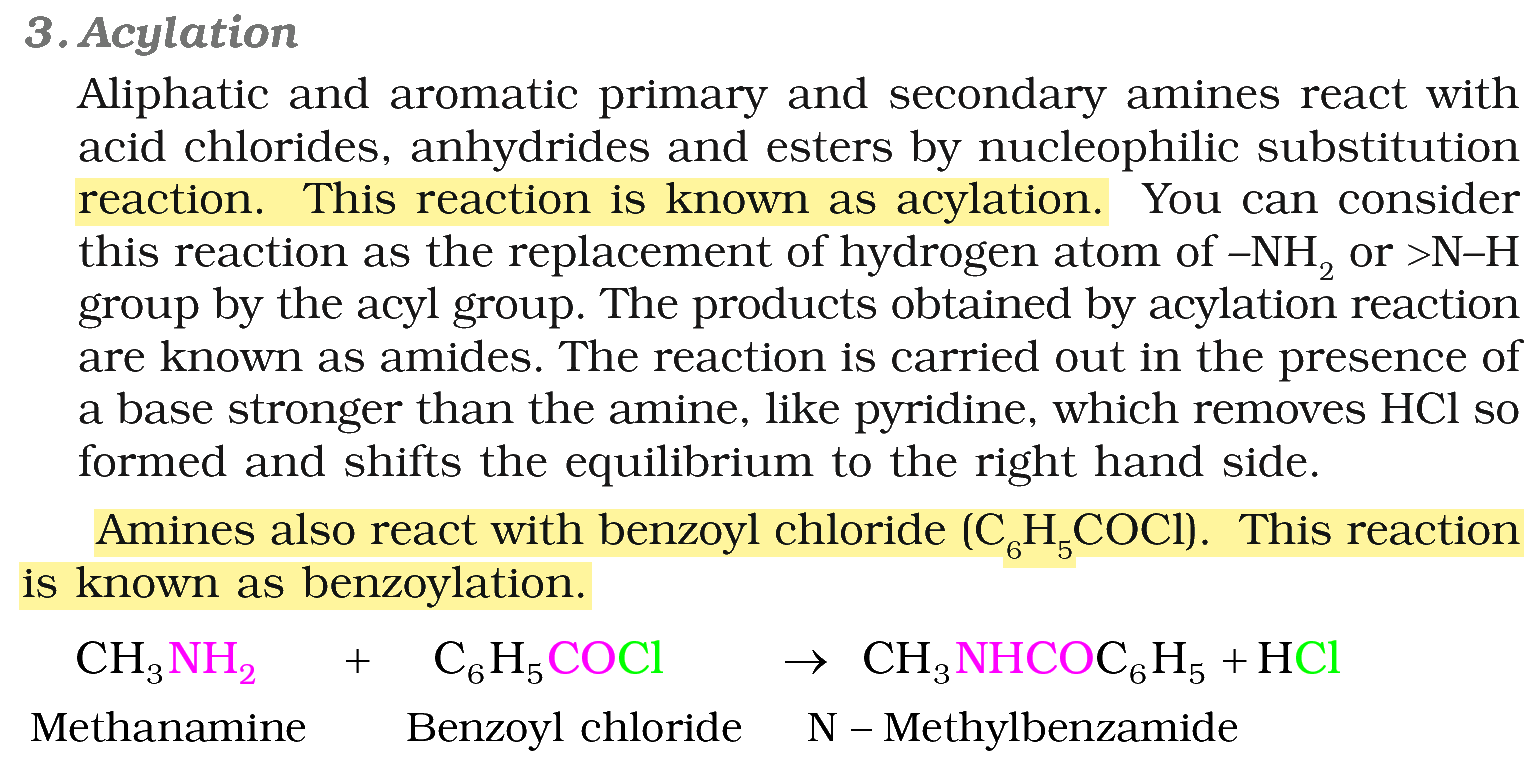
Aliphatic and aromatic primary and secondary amines react with acid chlorides, anhydrides, and esters by nucleophilic substitution reaction. This reaction is known as acylation. Both aliphatic and aromatic primary amines on heating with chloroform and ethanolic potassium hydroxide give corresponding isocyanide. Benzenesulphonyl chloride also known as Hinsberg’s reagent reacts with primary and secondary amines to form sulphonamide. Aniline reacts with bromine water at room temperature to give a white precipitate of 2,4,6-tribromoaniline. Aniline reacts with HNO3 in the presence of H2SO4 to give nitro derivatives. Aniline reacts with concentrated sulphuric acid to form anilinium hydrogensulphate which on heating with sulphuric acid at 453-473K produces p-aminobenzene sulphonic acid or sulphanilic acid.

Identify the major product (P) in the following chemical reaction.
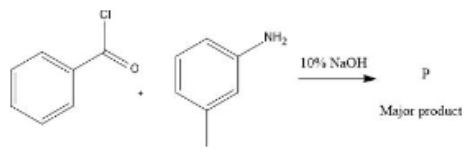
Figure for Q50

Answer & explanation+

Correct answer: option 2

The correct answer is Option (2) → N-(3-methylphenyl)benzamide

Primary and secondary amines react with acid chlorides by nucleophilic substitution: the lone pair on nitrogen attacks the C=O carbon and Cl is replaced. A hydrogen on the nitrogen is thus replaced by an acyl group (acylation). With benzoyl chloride this is called benzoylation. It is carried out in the presence of a base (here 10% NaOH), which removes the HCl formed and drives the reaction forward:

    \( \displaystyle \ce{C6H5COCl + H2N-C6H4-CH3} \xrightarrow{10\%\ \ce{NaOH}} \ce{C6H5CO-NH-C6H4-CH3 + HCl} \)

    \( \displaystyle \ce{HCl + NaOH -> NaCl + H2O} \)

Only the N–H bond takes part; nothing on either ring changes. So the benzoyl group (with no methyl) is joined to the nitrogen, and the methyl group stays meta to the nitrogen on the other ring. The product is N-(3-methylphenyl)benzamide.

Why the other options are incorrect

  • Option (1) 3-methyl-N-(3-methylphenyl)benzamide — Incorrect. It has an extra methyl group on the benzoyl ring, which benzoyl chloride does not carry.

  • Option (3) 3-methyl-N-phenylbenzamide — Incorrect. The methyl group is on the benzoyl ring instead of the amine ring; this would come from 3-methylbenzoyl chloride and aniline.

  • Option (4) N-(4-methylphenyl)benzamide — Incorrect. The methyl group is para to the nitrogen; this would come from p-toluidine, not from the meta-substituted amine given.

NCERT (2026-27 edition):
Acylation
Textbook extract

Advertisement

Practise more on Organic: Amines

Chapter-wise mocks on the real NTA exam screen, with solutions and your rank. Your first mocks are free.

Start free mocks →

Advertisement

Next questions

  1. Select the option which best expresses the same sentence in passive voice:We must endure what we cannot cure.English · Grammar: Active Passive Voice
  2. Choose the most appropriate option to fill in the blank in the given sentence:The residents of the locality were seething ____ resentment o…English · Grammar: Preposition
  3. The reagent used in Wurtz reaction isChemistry · Organic: Haloalkanes and Haloarenes
  4. Match the LIST-I with LIST-IILIST-ILIST-IIA.Rise and fall of the share marketI.Seasonal ComponentB.Continuous increase in the population of…Applied Maths. Section B2 · Time Based Data
  5. Profit and Loss Appropriation Account has the following features:(A) It is merely an extension of the Profit and Loss Account of the firm.(…Accountancy Part A · Accounting for Partnership
  6. When was the Subsidiary Alliance imposed on Awadh?History · Modern India: Rebels and the Raj
  7. Which one of the following organisms was used by Morgan to study genetic recombination?Biology · Principles of Inheritance and Variation
  8. “It is a type of plan which quantifies future facts and figures.” Identify:Business Studies · Planning
  9. Which one of the following aqueous solutions will boil at the highest temperature?Chemistry · Physical: Solutions
  10. Which of the following is not an example of in-situ biodiversity conservation?Environmental Studies · Environmental and Natural Resource Economics