
KMnO4 and K2Cr2O7 share some similarities.
(A) Both are strong oxidizing agents.
(B) Both can oxidize iodides to iodine in acidified solution.
(C) Both compounds are highly soluble in water.
(D) Chromates and permanganate ions share a tetrahedral structure.
Choose the correct answer from the options given below:
Answer & explanation
Correct answer: option 4
The correct answer is Option (4) → (A), (B) and (D) only
Potassium permanganate and potassium dichromate are the two most important oxidising agents among the transition metal compounds. Both are powerful oxidising agents in acidic solution:
\( \displaystyle \ce{Cr2O7^2- + 14H+ + 6e^- -> 2Cr^3+ + 7H2O} \)
\( \displaystyle \ce{MnO4^- + 8H+ + 5e^- -> Mn^2+ + 4H2O} \)
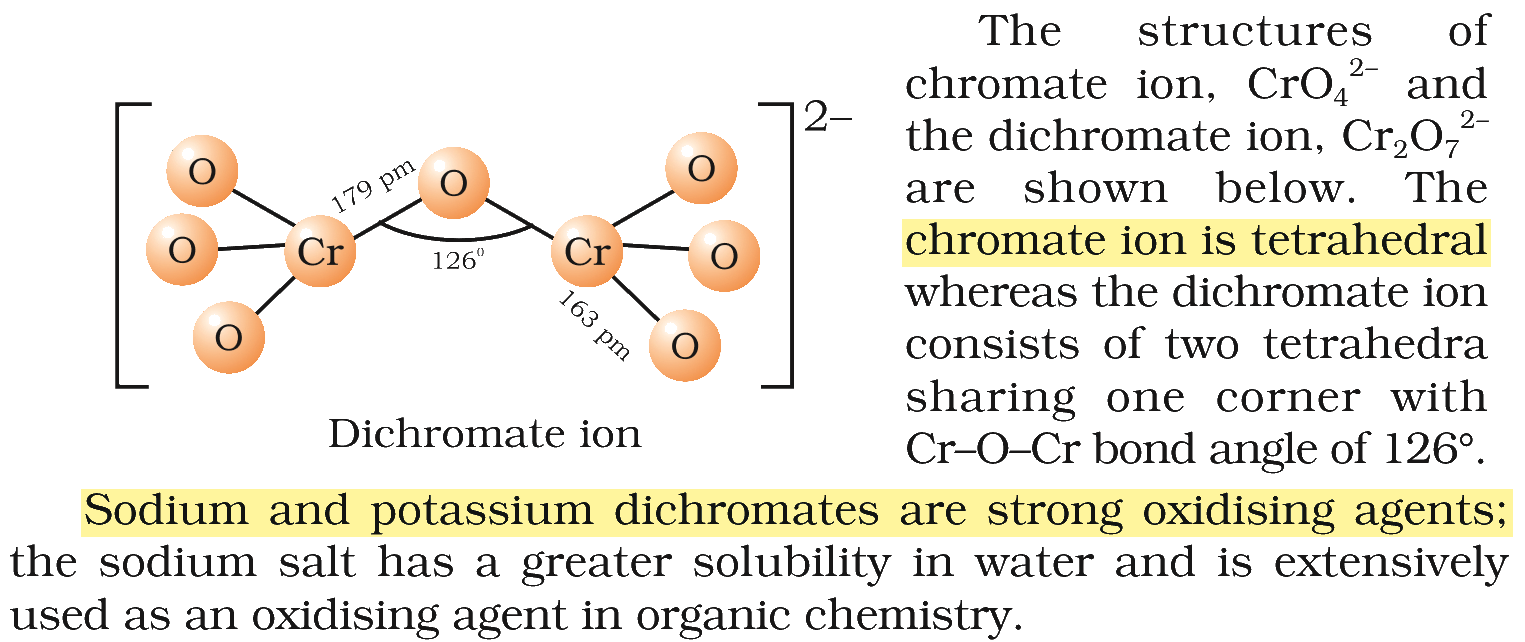
In structure, the chromate ion (\( \ce{CrO4^{2-}} \)) and the permanganate ion (\( \ce{MnO4^{-}} \)) are both tetrahedral. The dichromate ion is two tetrahedra sharing one oxygen atom.
(A) Both are strong oxidizing agents. — Correct. Both are widely used as oxidising agents, as the equations above show.
(B) Both can oxidize iodides to iodine in acidified solution. — Correct. \( \displaystyle \ce{Cr2O7^2- + 14H+ + 6I^- -> 2Cr^3+ + 7H2O + 3I2} \)
\( \displaystyle \ce{2MnO4^- + 16H+ + 10I^- -> 2Mn^2+ + 8H2O + 5I2} \)
(C) Both compounds are highly soluble in water. — Incorrect. \( \ce{KMnO4} \) is not very soluble (about 6.4 g per 100 g of water at 293 K). Potassium dichromate is made from sodium dichromate precisely because the potassium salt is the less soluble one.
(D) Chromates and permanganate ions share a tetrahedral structure. — Correct. In both ions, the metal sits at the centre of a tetrahedron of four oxygen atoms.
NCERT (2026-27 edition):
Oxides and Oxoanions of Metals – …
Potassium Permanganate – “… Potassium permanganate forms dark purple (almost black) crystals which are isostructural with those of KClO4. The salt is not very soluble in water (6.4 g/100 g of water at 293 K), but when heated it decomposes at 513 K. … The manganate and permanganate ions are tetrahedral; the π- bonding takes place by overlap of p orbitals of oxygen with d orbitals of manganese.”