Aldol Condensation
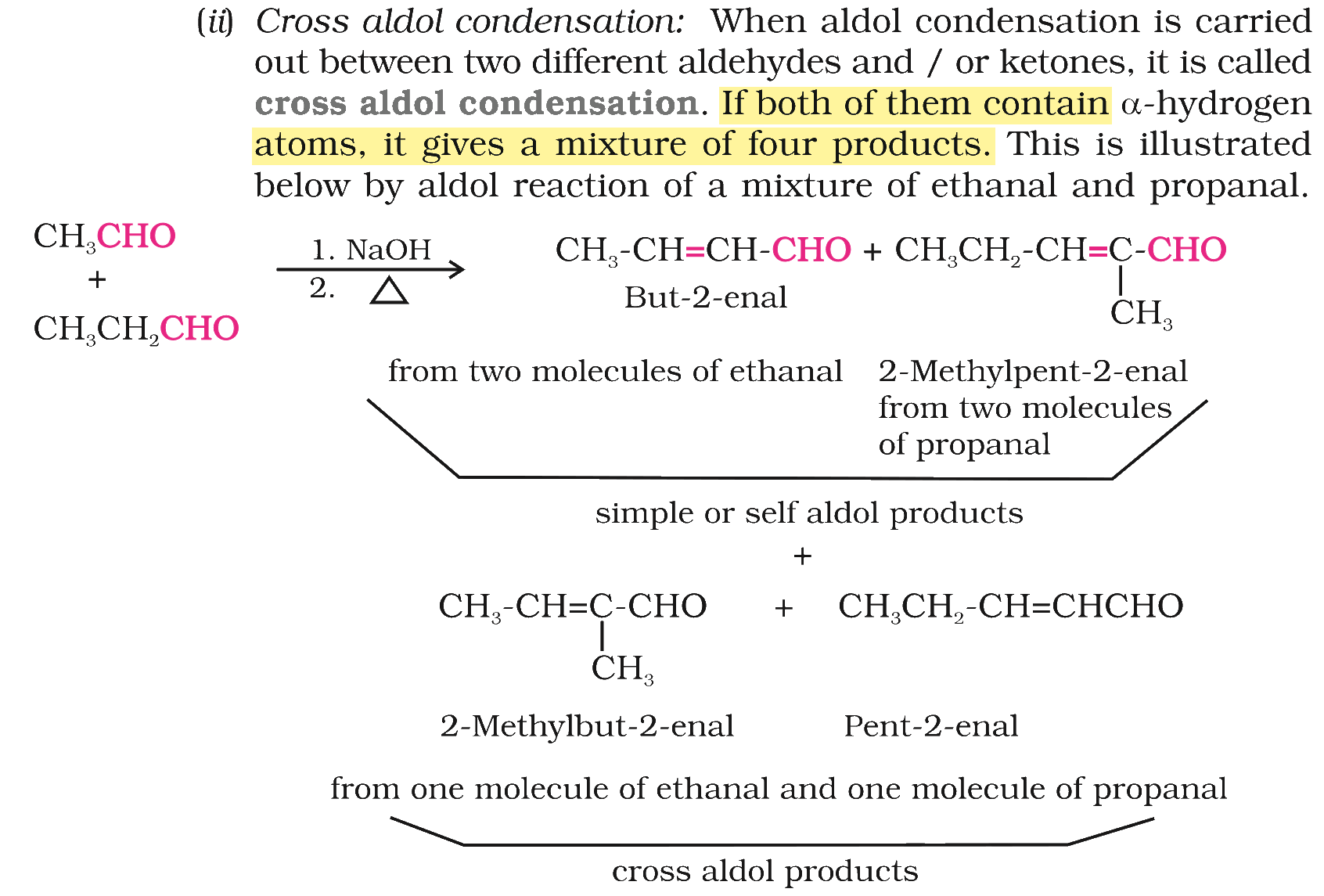
Aldehydes and ketones undergo a number of reactions due to the acidic nature of α-hydrogen. Aldehydes and ketones having at least one α-hydrogen undergo a reaction in the presence of dilute alkali as catalyst to form β-hydroxy aldehydes or β-hydroxy ketones, respectively. This is known as aldol reaction. The aldol and ketol readily lose water to give α, β-unsaturated carbonyl compounds, which are aldol condensation products; the reaction is called aldol condensation. When aldol condensation is carried out between two different aldehydes and/or ketones, it is called cross aldol condensation. Ethanal and propanal undergo this reaction to form mixture of products. However, benzaldehyde and acetophenone react to give only one product . Moreover, aldehydes which do not have an α-hydrogen atom, undergo self oxidation and reduction ( disproportionation) reaction on heating with concentrated alkali. The reaction is known as Cannizzaro reaction. In this reaction, one molecule of the aldehyde is reduced to alcohol while another is oxidised to carboxylic acid salt.
How many products are formed during the cross aldol condensation of propionaldehyde and acetaldehyde?
Answer & explanation
Correct answer: option 3
The correct answer is Option (3) → 4
In aldol condensation, a carbonyl compound with an α-hydrogen forms a carbanion in dilute alkali, which adds to the C=O group of another molecule; the β-hydroxy compound then loses water to give an α,β-unsaturated carbonyl compound. When both partners in a cross aldol condensation have α-hydrogens, each can act as the carbanion and each can be attacked, so four combinations are possible.
Ethanal (\( \ce{CH3CHO} \)) and propanal (\( \ce{CH3CH2CHO} \)) both have α-hydrogens. Each of them can form a carbanion, and each carbanion can attack the C=O group of either aldehyde. So there are 2 × 2 = 4 combinations: two self condensation products and two cross condensation products.
NCERT (2026-27 edition):
Cross Aldol Condensation