
CUETMOCK
  • Pricing
  • Mentors
Log inStart freeStart free mocks→

First test, then trust

Try a free CUET mock test.

Join 5,00,000+ students who rehearsed exam day on the exact NTA screen before sitting CUET. On the web and on Android.

Start free mocks →Get the Android app
CUETMOCK

India's #1 CUET Mock Test Platform. Original NCERT-based questions on the exact NTA exam screen — trusted by 5,00,000+ students since CUET 2022.

Get it onGoogle PlayScan to download the CUETMOCK app

Mock tests

  • CUET mock test series
  • Commerce mocks
  • Humanities (Arts) mocks
  • Science mocks
  • Languages & GAT mocks
  • Free practice questions
  • Pricing

Resources

  • CUET exam guide
  • CUET syllabus
  • Universities accepting CUET
  • Expert blogs
  • News & notifications
  • Webinars & counselling
  • CUET score calculator
  • How we estimate your rank
  • FAQs

Company

  • About us
  • Our leadership & team
  • Our toppers
  • Mentors
  • For schools
  • Contact us
  • Terms
  • Privacy
  • Refund policy

Talk to us

+91 7696 6630 56info@cuetmock.comWhatsApp us

Our other platforms

  • JEE Mock — For IIT-JEE aspirants
  • NEET Mock — For NEET aspirants

Newsletter

Exam updates, study material and offers — no spam.

© 2026 NYC Ventures Pvt. Ltd.

701-702, Royal Business Park, Zirakpur, Punjab - 140603

  • Terms of use
  • Privacy policy
  • Refund policy
  • Contact us

iCUETMOCK is an independent preparation platform, not affiliated with the National Testing Agency (NTA). Always check exam details on the official NTA website.

  • Home
  • Mock tests
  • CUET guide
  • Pricing
  • Log in
Home/Practice questions/Biology
BiologyEcosystem

The accumulation of a dark coloured amorphous substance that is highl…

The accumulation of a dark coloured amorphous substance that is highly resistant to microbial action and undergoes decomposition at an extremely slow rate is called:

Answer & explanation+

Correct answer: option 2

The correct answer is Option (2) → Humification

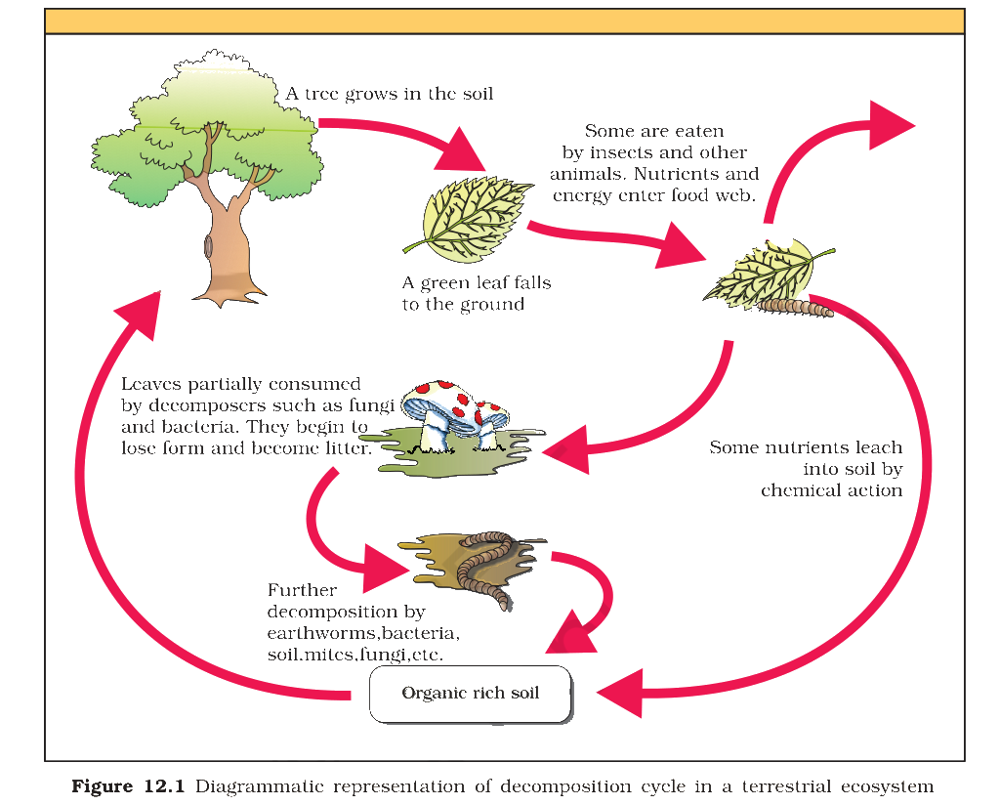
Decomposition goes through five steps: fragmentation, leaching, catabolism, humification and mineralisation. The question describes the step that makes humus.

(1) Mineralisation — Incorrect. This comes after humification. Some microbes break down the humus further and release inorganic nutrients into the soil.

(2) Humification — Correct. It builds up humus, a dark, amorphous (shapeless) substance. Humus is highly resistant to microbial action and decomposes at an extremely slow rate. Being colloidal, it works as a store of nutrients.

(3) Fragmentation — Incorrect. Detritivores such as earthworms break the detritus into smaller particles. No humus is formed at this step.

(4) Leaching — Incorrect. Water-soluble inorganic nutrients move down into the soil and get fixed as salts that plants cannot use. It does not form humus.

NCERT Extract:
Decomposition – “… Humification and mineralisation occur during decomposition in the soil. Humification leads to accumulation of a dark coloured amorphous substance called humus that is highly resistant to microbial action and undergoes decomposition at an extremely slow rate.”
Textbook figure

Advertisement

Practise more on Ecosystem

Chapter-wise mocks on the real NTA exam screen, with solutions and your rank. Your first mocks are free.

Start free mocks →

Advertisement

Next questions

  1. Match the LIST-I with LIST-IILIST-ILIST-IIA.In a L.P.P the objective function is alwaysI.FiniteB.Feasible region for an L.P.P is always aII…Applied Maths. Section B2 · Linear Programming
  2. What were the striking features of European art that influenced Company painting?Fine Arts · The Bengal School and Cultural Nationalism
  3. Which of the following are the methods to calculate the equated monthly installment (EMI) ?(A). Reducing balance method.(B). Increasing bal…Applied Maths. Section B2 · Financial Mathematics
  4. In which year, ‘Hampi’ was recognised as a site of national importance?History · Medieval India: An Imperial Capital: Vijayanagara
  5. Match the LIST-I with LIST-II:LIST-IGovernor-General/ViceroyLIST-IIPolicy/ InitiativeA.Lord William BentinckI.Modernized army equipmentB.Lo…History · Modern India: Rebels and the Raj
  6. Identify the correct facts about cancer.(A) Cancer cells continue to divide and build up a mass of cells called a tumour.(B) Cancer cells a…Biology · Human Health and Disease
  7. Fill in the blanks in List-I with the appropriate words given in List-IIList-IList-II(A) How often _____ you take coffee in a day?(I) does(…English · Grammar: Subject-Verb Agreement
  8. What is the impact of globalization and liberalization on Indian companies?Sociology · Social Change and Development in India: Change and Development in industrial Society
  9. If P= […] ,\ Q= […] and P=Q^2 , then x equals:Applied Maths. Section A · Matrices (Section A)
  10. Which one of the following index measures the basket of commodities purchased by the consumer?Economics · Macro Economics: National Income Accounting