Match the LIST-I with LIST-II:
| LIST-I Governor-General/Viceroy | LIST-II Policy/ Initiative | ||
| A. | Lord William Bentinck | I. | Modernized army equipment |
| B. | Lord Dalhousie | II. | Doctrine of Lapse |
| C. | Lord Wellesley | III. | Subsidiary Alliance |
| D. | Lord Henry Hardinge | IV. | Abolition of ‘Sati’ |
Choose the correct answer from the options given below:
Answer & explanation
Correct answer: option 2
The correct answer is Option (2) → A - IV, B - II, C - III, D - I
(A) Lord William Bentinck — this matches (IV) Abolition of ‘Sati’. From the late 1820s, under Governor-General Bentinck, the British set out to ‘reform’ Indian society through Western education and Western ideas. They passed a law abolishing sati in 1829 and later a law allowing Hindu widows to remarry.
(B) Lord Dalhousie — this matches (II) Doctrine of Lapse. Under this policy, a state whose ruler died without a natural son passed to the British, because the British refused to recognise an adopted son as the heir. Jhansi and Satara were annexed in this way. Dalhousie’s annexations, Awadh among them, caused deep anger in the years just before 1857.
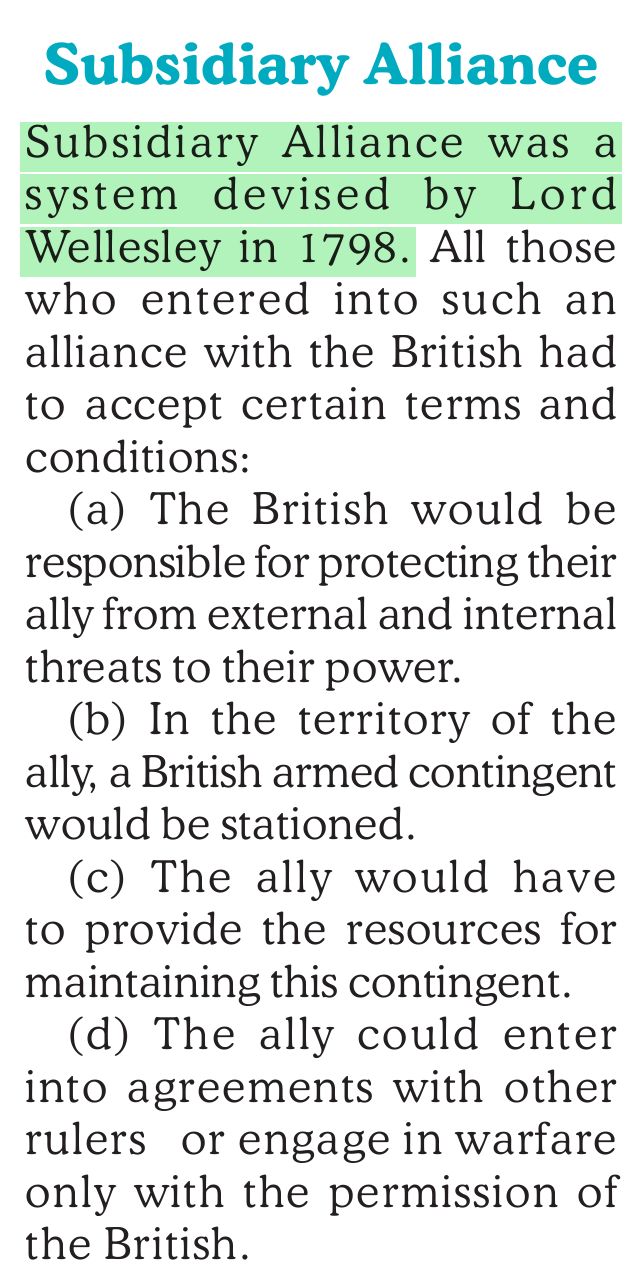
(C) Lord Wellesley — this matches (III) Subsidiary Alliance. Wellesley devised the Subsidiary Alliance in 1798. A ruler who accepted it had to disband his own army, keep British troops in his state and act on the advice of the British Resident.
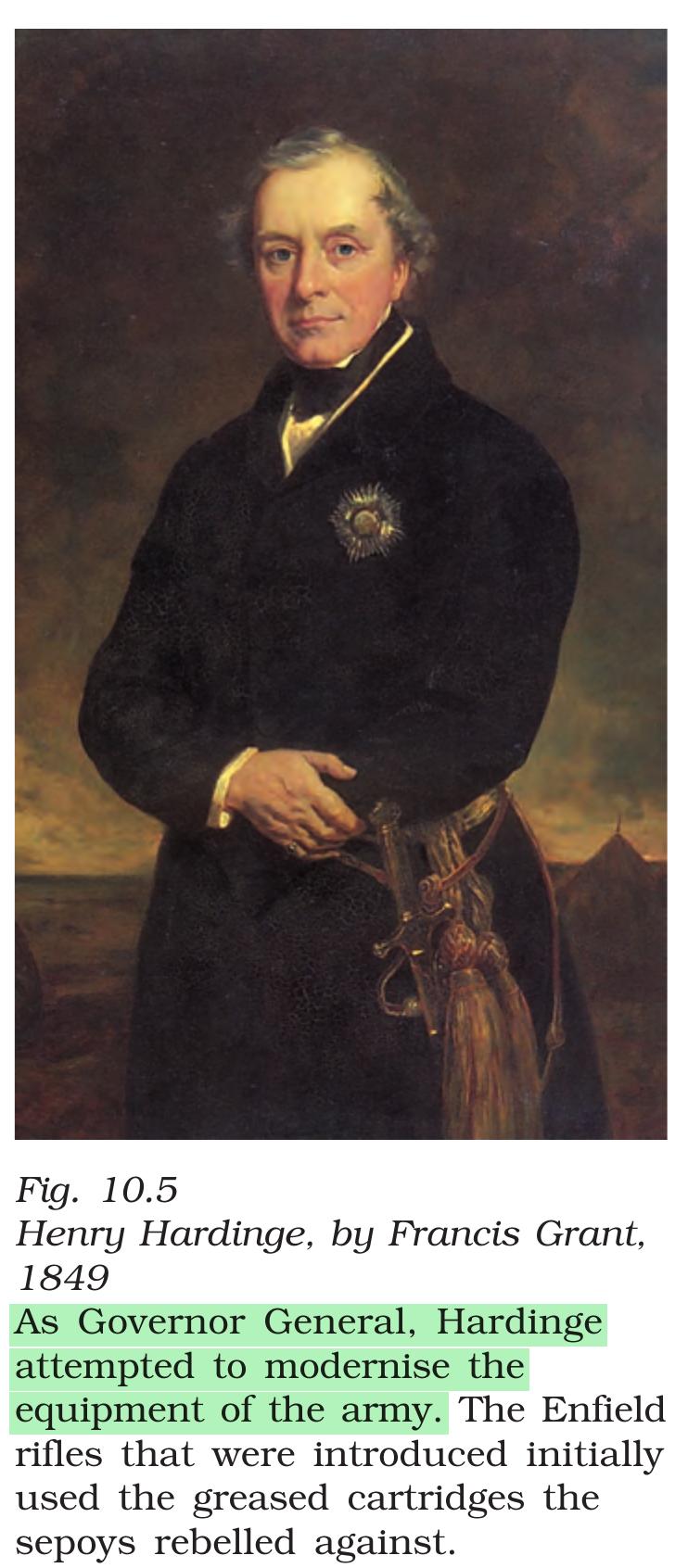
(D) Lord Henry Hardinge — this matches (I) Modernized army equipment. As Governor-General, Hardinge tried to modernise the equipment of the army. The Enfield rifles brought in under this plan used the greased cartridges that the sepoys later rebelled against.
Note: The term ‘Doctrine of Lapse’ is not used in the current NCERT book (2025-26). The book describes the policy as the British refusal to recognise adoption, on which they annexed kingdoms such as Jhansi and Satara, and it speaks of Lord Dalhousie’s annexations.
NCERT (2025-26): “1.5 Why did people believe in the rumours? … The rumours in 1857 begin to make sense when seen in the context of the policies the British pursued from the late 1820s. As you know, from that time, under the leadership of Governor General Lord William Bentinck, the British adopted policies aimed at ‘reforming’ Indian society by introducing Western education, Western ideas and Western institutions. With the cooperation of sections of Indian society they set up English-medium schools, colleges and universities which taught Western sciences and the liberal arts. The British established laws to abolish customs like sati (1829) and to permit the remarriage of Hindu widows. On a variety of pleas, like misgovernment and the refusal to recognise adoption, the British annexed not only Awadh, but many other kingdoms and principalities like Jhansi and Satara.… 2.2 ‘The life was gone out of the body’ … Lord Dalhousie’s annexations created disaffection in all the areas and principalities that were annexed but nowhere more so than in the kingdom of Awadh in the heart of North India.…”
|