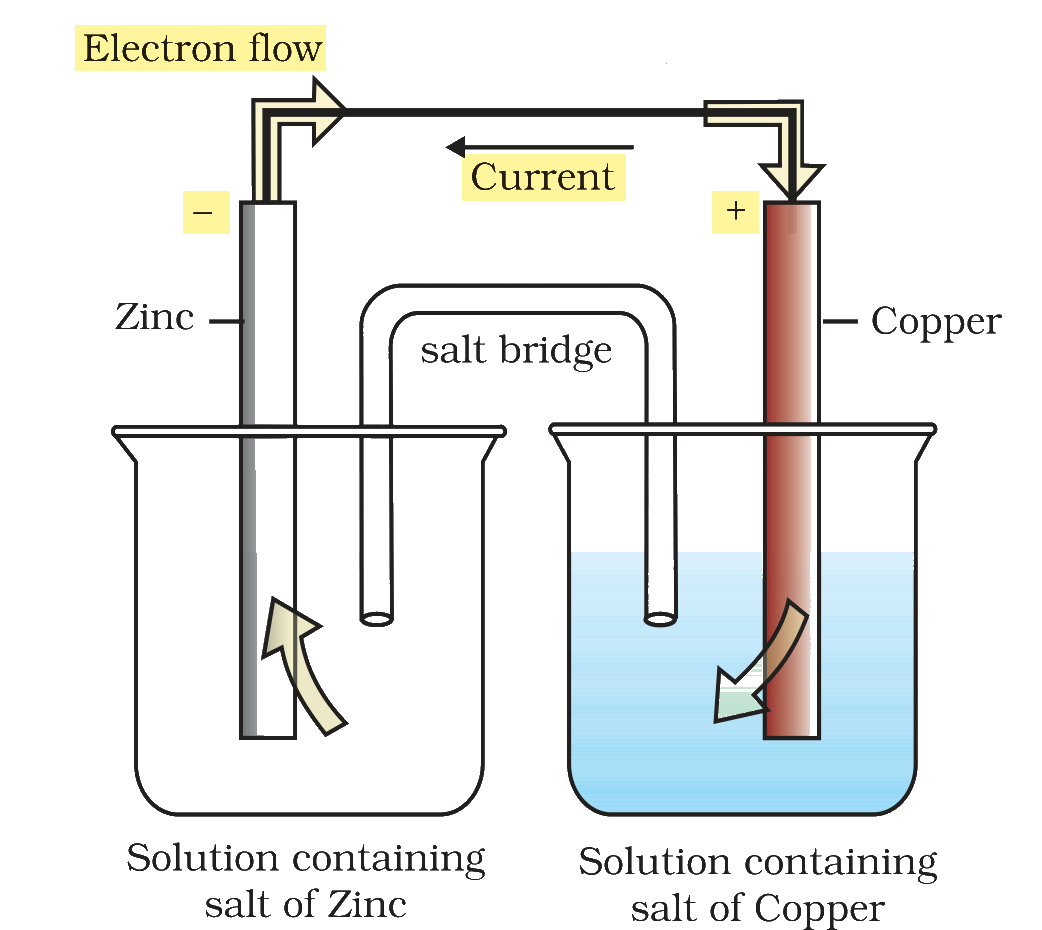
Daniell Cell
Electrochemistry is the study of the production of electricity from energy released during spontaneous chemical reactions and the use of electrical energy to bring about non-spontaneous chemical transformations. The cell below represents Daniell cell which converts the chemical energy liberated during the redox reaction to electrical energy.
Zn(s) + Cu2+(aq) → Zn2+(aq) + Cu(s)
The reaction is a combination of two half-cell reactions, one called the oxidation half-cell and the other called the reduction half-cell. Each half-cell consists of a metallic electrode dipped into an electrolyte. The two half-cells are connected through a metallic wire and switch externally. The electrolyte of the two half cells is connected internally through a salt bridge. At each electrode-electrolyte interface there is a tendency for metal ions from the solution to deposit on the metal electrode, trying to make it positively charged. At the same time, metal atoms of the electrode have a tendency to go into the solution as ions and leave behind the electrons at the electrode, trying to make it negatively charged. A potential difference develops between the electrode and the electrolyte, which is called electrode potential. When the concentrations of all the species involved in a half-cell is unity, then the electrode potential is known as the standard electrode potential.
For a general half-cell; Mn+(aq) + ne− → M(s), the Nernst equation is written as
\( E_{(M^{n+}/M)}=E^{o}_{(M^{n+}/M)}-\frac{RT}{nF}\ln\frac{1}{[M^{n+}]} \)
where \( E^{o}_{(M^{n+}/M)} \) is the standard reduction potential of the half-cell, R is gas constant (8.314 J K−1 mol−1), F is Faraday constant (96487 C mol−1), T is temperature in kelvin and [Mn+] is the concentration of the species, Mn+.
Which of the following statements is not true for Daniell cell?
Answer & explanation
Correct answer: option 4
The correct answer is Option (4) → Cathode is negatively charged
In a galvanic cell such as the Daniell cell, oxidation takes place at the anode and reduction at the cathode:
\( \displaystyle \text{Anode (zinc):}\quad \ce{Zn(s) -> Zn^2+(aq) + 2e^-} \)
\( \displaystyle \text{Cathode (copper):}\quad \ce{Cu^2+(aq) + 2e^- -> Cu(s)} \)
The electrons released by zinc collect on the zinc rod, so the anode becomes the negative electrode. These electrons travel through the external wire to the copper rod, where \( \ce{Cu^{2+}} \) ions take them up, so the cathode is the positive electrode.
Option (1) The electrons flow from the zinc electrode to the copper electrode. — True for the Daniell cell. Electrons are released at the zinc anode and consumed at the copper cathode, so they move from zinc to copper in the external circuit.
Option (2) The oxidation takes place at zinc electrode. — True for the Daniell cell. Zinc atoms lose electrons and enter the solution as \( \ce{Zn^{2+}} \) ions.
Option (3) The current flows from the copper electrode to the zinc electrode. — True for the Daniell cell. Conventional current flows opposite to the flow of electrons, so in the external circuit it flows from copper to zinc.
Option (4) Cathode is negatively charged — Not true for the Daniell cell. The copper cathode is the positive electrode; the zinc anode, where electrons collect, is the negative one.
NCERT (2026-27 edition):
Electrochemical Cells – “We had studied the construction and functioning of Daniell cell …. This cell converts the chemical energy liberated during the redox reaction
\( \ce{Zn(s) + Cu^2+(aq) -> Zn^2+(aq) + Cu(s)} \qquad (2.1) \)
to electrical energy and has an electrical potential equal to 1.1 V when concentration of Zn2+ and Cu2+ ions is unity (1 mol dm–3). Such a device is called a galvanic or a voltaic cell.”