In Hofmann bromamide degradation reaction:
Answer & explanation
Correct answer: option 1
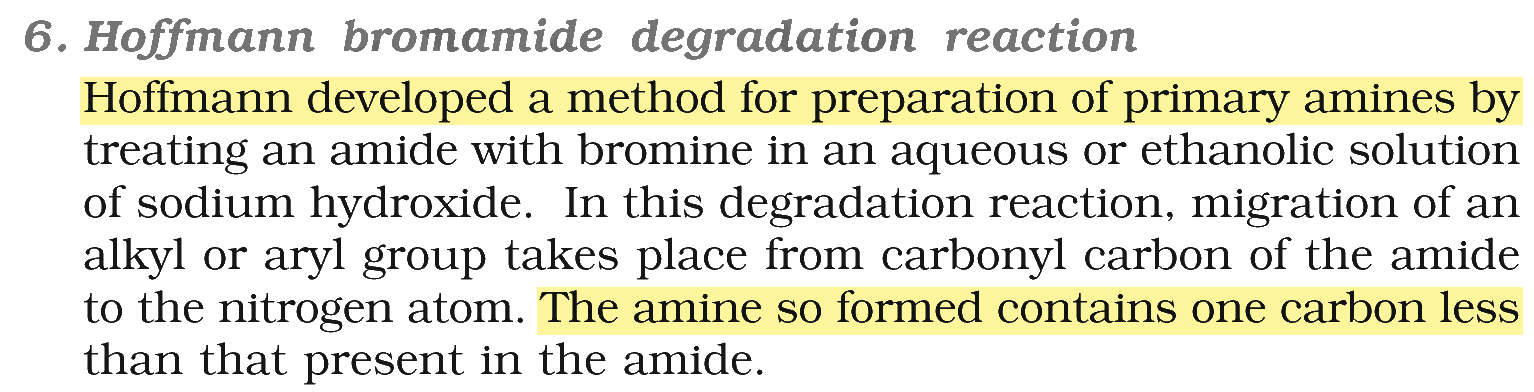
The correct answer is Option (1) → an amide is converted to primary amine with one carbon atom less than starting amide.
In the Hofmann bromamide degradation, the carbonyl carbon of the amide is lost as carbonate, so the product is a primary amine with one carbon atom less:
\( \displaystyle \ce{R-CONH2 + Br2 + 4NaOH -> R-NH2 + Na2CO3 + 2NaBr + 2H2O} \)
For example, benzamide (7 carbon atoms) gives aniline (6 carbon atoms):
\( \displaystyle \ce{C6H5CONH2} \xrightarrow{\ce{Br2 + NaOH}} \ce{C6H5NH2} \)
This makes the reaction useful for stepping down a carbon chain by one carbon.
Why the other options are incorrect
Option (2) a nitrile group is reduced to primary amine — Incorrect. Nitriles are reduced by \( \ce{LiAlH4} \) or Na(Hg)/\( \ce{C2H5OH} \), and the amine keeps all the carbon atoms:
\( \displaystyle \ce{R-C#N} \xrightarrow[\text{(ii) }\ce{H2O}]{\text{(i) }\ce{LiAlH4}} \ce{R-CH2-NH2} \)
Option (3) aromatic nitro compounds are reduced to aniline — Incorrect. This is done with Sn/HCl or Fe/HCl, not with \( \ce{Br2} \)/NaOH:
\( \displaystyle \ce{C6H5NO2 + 6[H]} \xrightarrow{\ce{Sn}/\ce{HCl}} \ce{C6H5NH2 + 2H2O} \)
Option (4) aniline is converted to sulphanilic acid — Incorrect. This is sulphonation of aniline by heating its salt with concentrated \( \ce{H2SO4} \) at 453–473 K:
\( \displaystyle \ce{C6H5NH2 + H2SO4 -> C6H5NH3^+HSO4^-} \xrightarrow{453-473\ \mathrm{K}} \text{sulphanilic acid} + \ce{H2O} \)
NCERT (2026-27 edition):
Hofmann Bromamide Degradation Reaction