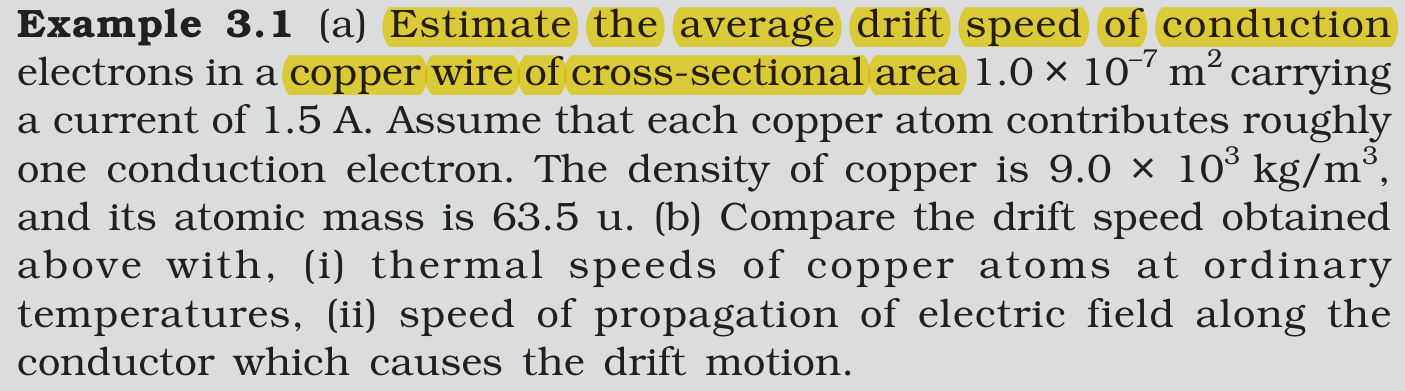
A copper wire with an area of cross-section 1.0 × 10⁻⁷ m2 and electron density 8.5 × 1028 m−3 is carrying a current of 0.85 A. The drift velocity of the electrons is
Answer & explanation
Correct answer: option 2
The correct answer is Option (2) → 6.25 × 10⁻⁴ m/s
The current in a conductor is carried by electrons moving with the drift velocity, so \( I = neAv_d \), where n is the number density of free electrons.
\( \displaystyle v_d = \frac{I}{neA} \)
\( \displaystyle v_d = \frac{0.85\,\mathrm{A}}{8.5\times10^{28}\,\mathrm{m^{-3}} \times 1.6\times10^{-19}\,\mathrm{C} \times 1.0\times10^{-7}\,\mathrm{m^{2}}} \)
\( \displaystyle v_d = \frac{0.85}{1.36\times10^{3}}\,\mathrm{m\,s^{-1}} \)
\( v_d = 6.25\times10^{-4}\,\mathrm{m\,s^{-1}} \)
Note: NTA picked this question from an NCERT (2026-27) example and changed the figures. Do not ignore NCERT while practising numericals.
NCERT (2026-27):
Drift of Electrons and the Origin of Resistivity – …