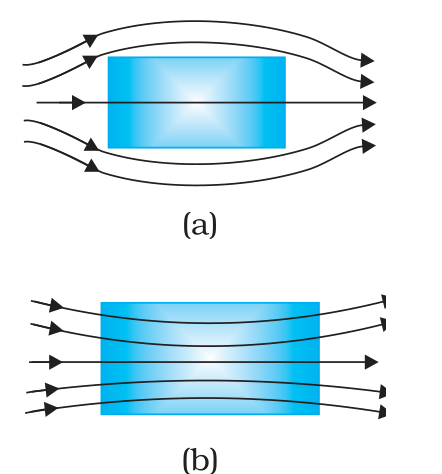
When a specific type of magnetic material (shaded area) is placed in a region of an external magnetic field, the figure given below typically represents the magnetic field line configuration.
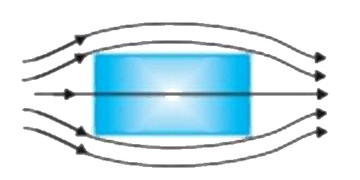
Identify the material among the following which may give rise to such a configuration.
A. Lead
B. Cobalt
C. Water
D. Calcium
Choose the correct answer from the options given below:
Answer & explanation
Correct answer: option 3
The correct answer is Option (3) → A and C only
In the figure the field lines bend away from the material, so fewer lines pass through it than through the surrounding space. This is the behaviour of a diamagnetic material: its induced magnetisation opposes the applied field, so the field inside is weakened and the material is pushed towards weaker field regions.
(A) Lead — Correct. Lead is diamagnetic.
(B) Cobalt — Incorrect. Cobalt is ferromagnetic; field lines crowd strongly into it instead of avoiding it.
(C) Water — Correct. Water is diamagnetic.
(D) Calcium — Incorrect. Calcium is paramagnetic; field lines are slightly concentrated inside it.
NCERT (2026-27):
Diamagnetism – “… Figure 5.7(a) shows a bar of diamagnetic material placed in an external magnetic field. The field lines are repelled or expelled and the field inside the material is reduced.”
Diamagnetism – “… Some diamagnetic materials are bismuth, copper, lead, silicon, nitrogen (at STP), water and sodium chloride.”
Paramagnetism – “… Some paramagnetic materials are aluminium, sodium, calcium, oxygen (at STP) and copper chloride.”