
CUETMOCK
  • Pricing
  • Mentors
Log inStart freeStart free mocks→

First test, then trust

Try a free CUET mock test.

Join 5,00,000+ students who rehearsed exam day on the exact NTA screen before sitting CUET. On the web and on Android.

Start free mocks →Get the Android app
CUETMOCK

India's #1 CUET Mock Test Platform. Original NCERT-based questions on the exact NTA exam screen — trusted by 5,00,000+ students since CUET 2022.

Get it onGoogle PlayScan to download the CUETMOCK app

Mock tests

  • CUET mock test series
  • Browse all papers
  • Commerce mocks
  • Humanities (Arts) mocks
  • Science mocks
  • Languages & GAT mocks
  • Free practice questions
  • Pricing

Resources

  • CUET exam guide
  • CUET syllabus
  • Universities accepting CUET
  • Expert blogs
  • News & notifications
  • Webinars & counselling
  • CUET score calculator
  • How we estimate your rank
  • FAQs

Company

  • About us
  • Our leadership & team
  • Our toppers
  • Mentors
  • For schools
  • Contact us
  • Terms
  • Privacy
  • Refund policy

Talk to us

+91 7696 6630 56info@cuetmock.comWhatsApp us

Our other platforms

  • JEE Mock — For IIT-JEE aspirants
  • NEET Mock — For NEET aspirants

Newsletter

Exam updates, study material and offers — no spam.

© 2026 NYC Ventures Pvt. Ltd.

701-702, Royal Business Park, Zirakpur, Punjab - 140603

  • Terms of use
  • Privacy policy
  • Refund policy
  • Contact us

iCUETMOCK is an independent preparation platform, not affiliated with the National Testing Agency (NTA). Always check exam details on the official NTA website.

  • Home
  • Mock tests
  • CUET guide
  • Pricing
  • Log in
Home/Practice questions/Physics
PhysicsDual Nature of Radiation and Matter

Match List-I with List-IIChoose the correct answer from the options g…

Match List-I with List-II
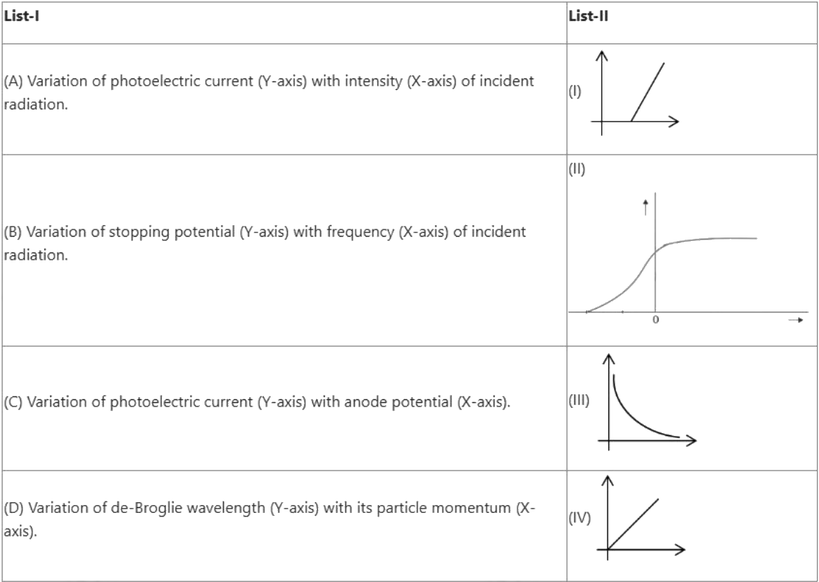
Figure for the question

Choose the correct answer from the options given below:

Answer & explanation+

Correct answer: option 2

The correct answer is Option (2) → (A) - (IV), (B) - (I), (C) - (II), (D) - (III)

Each graph follows from the laws of the photoelectric effect and the de Broglie relation.

(A) Variation of photoelectric current (Y-axis) with intensity (X-axis) of incident radiation. — this matches (IV), the straight line through the origin: the photocurrent is proportional to the intensity.

(B) Variation of stopping potential (Y-axis) with frequency (X-axis) of incident radiation. — this matches (I), the straight line meeting the frequency axis at the threshold frequency \( \nu_0 \), by Einstein’s equation:

    \( \displaystyle V_0 = \frac{h}{e}\,\nu - \frac{\phi_0}{e} \)

(C) Variation of photoelectric current (Y-axis) with anode potential (X-axis). — this matches (II), the curve that starts at the negative stopping potential and levels off at the saturation current.

(D) Variation of de-Broglie wavelength (Y-axis) with its particle momentum (X-axis). — this matches (III), the falling curve (a rectangular hyperbola), since the wavelength is inversely proportional to the momentum:

    \( \displaystyle \lambda = \frac{h}{p} \)

NCERT (2026-27):
Effect of Potential on Photoelectric Current – “… It is found that the photoelectric current increases with increase in positive (accelerating) potential. At some stage, for a certain positive potential of plate A, all the emitted electrons are collected by the plate A and the photoelectric current becomes maximum or saturates.”


Effect of Frequency of Incident Radiation on Stopping Potential – “… (i) For a given photosensitive material and frequency of incident radiation (above the threshold frequency), the photoelectric current is directly proportional to the intensity of incident light ….”


Effect of Frequency of Incident Radiation on Stopping Potential – “… (iii) For a given photosensitive material, there exists a certain minimum cut-off frequency of the incident radiation, called the threshold frequency, below which no emission of photoelectrons takes place, no matter how intense the incident light is. Above the threshold frequency, the stopping potential or equivalently the maximum kinetic energy of the emitted photoelectrons increases linearly with the frequency of the incident radiation, but is independent of its intensity ….”


Wave Nature of Matter – “… De Broglie proposed that the wave length \( \lambda \) associated with a particle of momentum p is given as

    \( \displaystyle \lambda = \frac{h}{p} = \frac{h}{mv} \qquad (11.5) \)”

Advertisement

Practise more on Dual Nature of Radiation and Matter

Chapter-wise mocks on the real NTA exam screen, with solutions and your rank. Your first mocks are free.

Start free mocks →

Advertisement

Next questions

  1. Fill in the blanks in the sentences given in List-I by choosing the appropriate idioms given in List-II.List-I (Sentences)List-II (Idioms)(…English · Grammar: Idioms
  2. ‘BOD’ test is a measures of _______ in a water body.Environmental Studies
  3. Choose the most appropriate figures of speech from List- I for the lines given in List-II :-List- I (Figures of speech)List-II (Sentence)(A…English · Figure of Speech
  4. In the following chemical reaction, the major product obtained will be:RMgBr + D2O →Chemistry · Organic: Haloalkanes and Haloarenes
  5. 600 shares of Rs 10 each were forfeited for non-payment of Rs 2 per share on first call and Rs 5 per share on final call. Share Forfeiture…Accountancy Part A · Accounting for Shares
  6. Muhammed Ibn Ahmad Abu Raithan al-Baruni came from which country?General Aptitude Test · General Knowledge
  7. Arrange the following historical events in chronological order:(A) The ‘diwani’ of Bengal transferred to the East India Company(B) Nadir Sh…History · Medieval India: Peasants, Zamindars and the State
  8. Which of the following statements are correct regarding untranslated regions (UTR)?A. UTR is present only at 5′ end.B. UTR is required for…Biology · Molecular Basis of Inheritance
  9. A function f(x)=sin x(1+cos x),x∈[0,π] has a local maxima at x=Maths. Section B1 · Applications of Derivatives
  10. The beginning of the sentence has been given below. Rearrange the following phrases into a meaningful sentence.In circumstances, such as a…English · Arrange in Meaningful Sequence