
Coordination Chemistry
In the IUPAC nomenclature of coordination compounds, the groups that surround the central atom must be identified in the name. They are listed as prefixes to the name of the central atom along with any appropriate multipliers. Isomerism in Coordination Compounds are mainly of 2 types (A) Stereoisomerism viz: (i) Geometrical isomerism (ii) Optical isomerism and (B) Structural isomerism viz: (i) Linkage isomerism (ii) Coordination isomerism (iii) Ionisation isomerism (iv) Solvate isomerism. Many approaches have been put forth to explain the nature of bonding in coordination compounds viz. Valence Bond Theory (VBT), Crystal Field Theory (CFT), Ligand Field Theory (LFT) and Molecular Orbital Theory (MOT). The magnetic properties of coordination compounds can be measured by the magnetic susceptibility experiments. The results can be used to obtain information about the number of unpaired electrons and hence, structures adopted by metal complexes.
Which of the following will show linkage Isomerism?
Answer & explanation
Correct answer: option 1
The correct answer is Option (1) → [Co(NH3)5(NO2)]Cl2
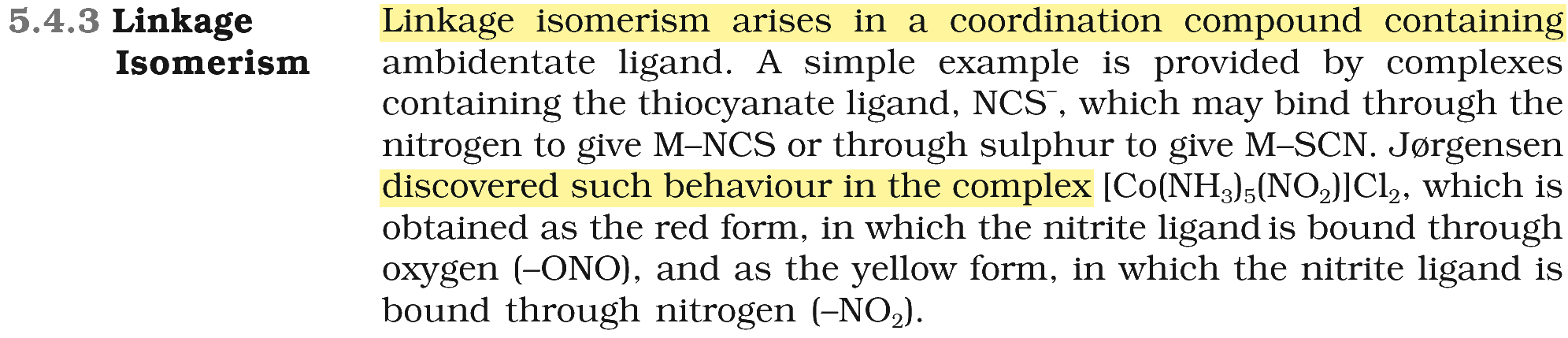
Linkage isomerism arises when a complex contains an ambidentate ligand, one that has two different donor atoms but binds through only one of them at a time. The two isomers have the same formula but differ in which atom is bonded to the metal. Common ambidentate ligands:
NO2−: through N (nitrito-N) or through O (nitrito-O, –ONO)
SCN−: through S (thiocyanato-S) or through N (thiocyanato-N)
CN−: through C (cyanido) or through N (isocyanido)
\( \ce{[Co(NH3)5(NO2)]Cl2} \) contains the ambidentate NO2− ligand, so it exists as two linkage isomers:
\( \ce{[Co(NH3)5(NO2)]Cl2} \): bonded through N (yellow)
\( \ce{[Co(NH3)5(ONO)]Cl2} \): bonded through O (red)
Why the other options are incorrect
Option (2) [Co(NH3)6][Cr(Cl)6] — Incorrect. Both the cation and the anion are complexes, so it shows coordination isomerism (ligands can swap between Co and Cr), not linkage isomerism; \( \ce{NH3} \) and \( \ce{Cl^{-}} \) have only one donor atom.
Option (3) [Co(NH3)5(SO4)]Br — Incorrect. It shows ionisation isomerism with \( \ce{[Co(NH3)5Br]SO4} \), where sulphate and bromide exchange places.
Option (4) [Cr(H2O)6]Cl3 — Incorrect. It shows solvate (hydrate) isomerism with \( \ce{[Cr(H2O)5Cl]Cl2.H2O} \) and related forms, where water moves between the coordination sphere and the lattice.
NCERT (2026-27 edition):
Linkage Isomerism
Note: The same/similar question has been asked in different years by NTA as per the details given below:
| 2026 | 2025 | 2024 | 2023 | 2022 |
|---|---|---|---|---|
| 20-05 S2 | 14-05 S2 | – | – | – |