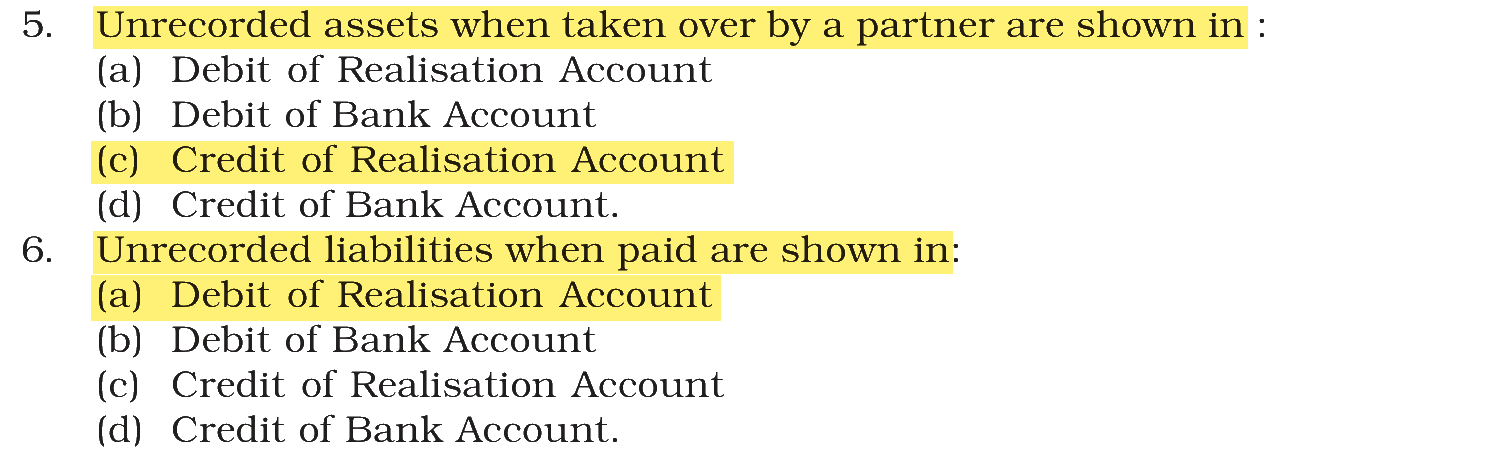
Match List-I with List-II
| List-I | List-II |
|---|---|
| (A) At the time of dissolution, unrecorded assets when taken over by a partner are shown in | (I) Debit of Realisation Account |
| (B) At the time of dissolution, unrecorded liabilities when paid are shown in | (II) Credit of Partners' capital Account |
| (C) At the time of admission of a partner, General Reserve will be shown in | (III) Debit of Partners' capital Account |
| (D) At the time of admission of a partner, Debit balance of Profit & Loss A/c will be shown in | (IV) Credit of Realisation Account |
Choose the correct answer from the options given below:
Answer & explanation
Correct answer: option 4
The correct answer is Option (4) → (A) - (IV), (B) - (I), (C) - (II), (D) - (III)
Two items concern the Realisation Account on dissolution, and two concern the old partners’ capital accounts on admission.
(A) At the time of dissolution, unrecorded assets when taken over by a partner are shown in — this matches (IV) Credit of Realisation Account. Taking over the asset is a realisation, so Realisation Account is credited and the partner’s capital account is debited.
(B) At the time of dissolution, unrecorded liabilities when paid are shown in — this matches (I) Debit of Realisation Account. Paying a liability is a cost of closing the firm, so Realisation Account is debited and Cash or Bank is credited.
(C) At the time of admission of a partner, General Reserve will be shown in — this matches (II) Credit of Partners’ capital Account. The reserve is profit earned in the past and belongs to the old partners, so it is credited to their capital accounts in the old ratio.
(D) At the time of admission of a partner, Debit balance of Profit & Loss A/c will be shown in — this matches (III) Debit of Partners’ capital Account. It is an accumulated loss of the old firm, so it is debited to the old partners in the old ratio.
NCERT (2026-27 edition):
NCERT (2026-27 edition): |