Read the passage carefully and answer the following questions:
Determination of Income in Two-sector Model
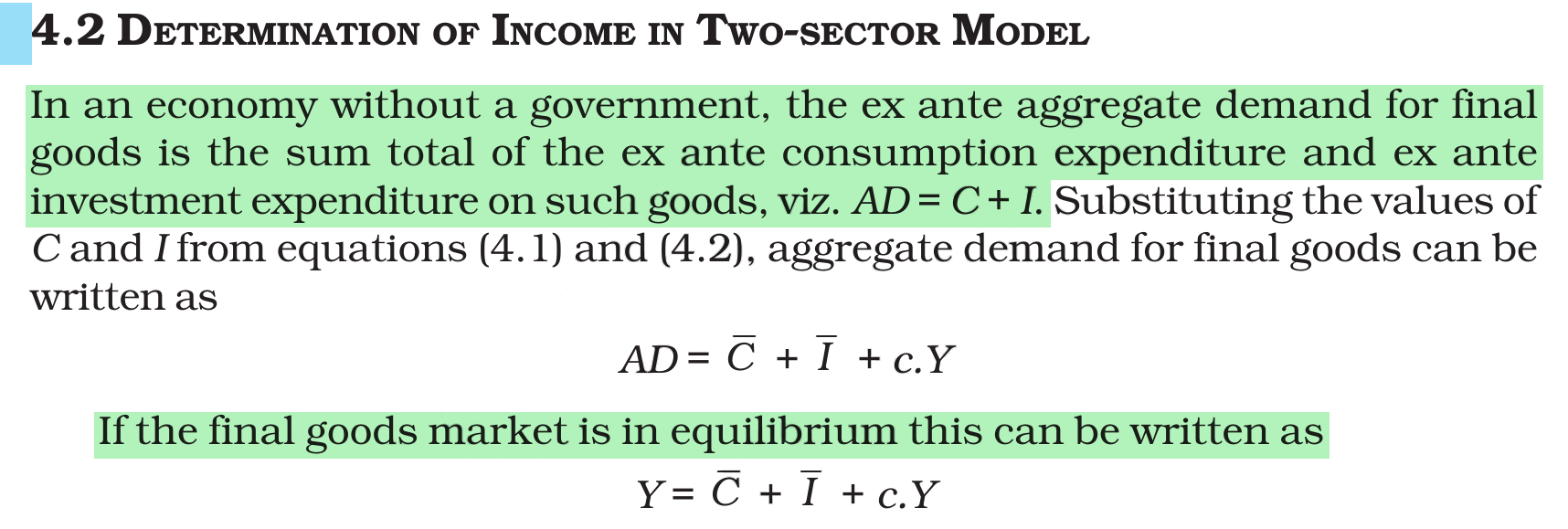
In an economy without a government, the ex ante aggregate demand for final goods is the sum total of the ex ante consumption expenditure and ex-ante investment expenditure on such goods. Ex-ante supply is equal to ex ante demand only when the final goods market, and hence the economy, is in equilibrium. If ex ante demand for final goods falls short of the output of final goods that the producers have planned to produce in a given year, stocks will be piling up in the warehouses, which may be considered as an unintended accumulation of inventories. Change in inventory is called inventory investment. It can be negative as well as positive: if there is a rise in inventory, it is positive inventory investment, while a depletion of inventory is negative inventory investment. The inventory investment can take place for two reasons: (i) the firm decides to keep some stocks for various reasons (ii) the sales differ from the planned level of sales, in which case the firm has to add to/run down existing inventories.
The algebraic expression of aggregate demand for final goods can be written as:
Answer & explanation
Correct answer: option 4
The correct answer is Option (4) → AD = C + I
A two-sector economy has no government and no foreign trade, so final goods are bought only by households, for consumption, and by firms, for investment. The ex ante aggregate demand for final goods is therefore planned consumption plus planned investment:
AD = C + I
Putting in the consumption function C = C̄ + cY and the autonomous investment I = Ī gives the fuller form AD = C̄ + Ī + cY.
Why the other options are incorrect
Option (1) AS = C + I + cY — Incorrect. The right-hand side is the fuller form of aggregate demand, but it has been labelled AS, aggregate supply. AD has been turned into AS, so one letter makes a true formula false. Check every letter of a formula, not just its shape.
Option (2) Y = C + I + cY — Incorrect. This sets planned output Y equal to aggregate demand. It is the condition for equilibrium in the final goods market, which holds only at the equilibrium level of output, not the expression for aggregate demand itself.
Option (3) Y = A + cY — Incorrect. This is the same equilibrium condition, with the two autonomous terms added up into A, the total autonomous expenditure. It too equates output with demand instead of stating what demand is made of.
NCERT: Introductory Macroeconomics — Chapter 4: Determination of Income and Employment (2025-26)
|