Arrange the following statements about the effect of change in demand for foreign goods on foreign exchange rate in open economy in correct sequence.
(A) It leads to a shift in the demand curve towards right.
(B) More Rupee needed against a dollar.
(C) Demand for foreign goods and services increases in the economy.
(D) It leads to depreciation of the domestic currency in terms of dollars.
Choose the correct answer from the options given below:
Answer & explanation
Correct answer: option 3
The correct answer is Option (3) → (C), (A), (B), (D)
The exchange rate is the price of one unit of foreign currency in terms of the domestic currency, for example the number of rupees paid for one dollar. Under a flexible exchange rate it is set, like any other price, by the demand for and supply of foreign exchange. Indians demand dollars because they need them to buy foreign goods and services, to travel abroad or to invest abroad.
When the rupee price of a dollar rises, more rupees must be paid for each dollar, so the rupee is worth less in terms of the dollar; this fall in its value is called depreciation of the domestic currency. A rise in the demand for imports reaches the rupee one step after another:
(C) Demand for foreign goods and services increases in the economy. — This is the starting point: Indians want more foreign goods and services, for example more travel abroad, and need more dollars to pay for them.
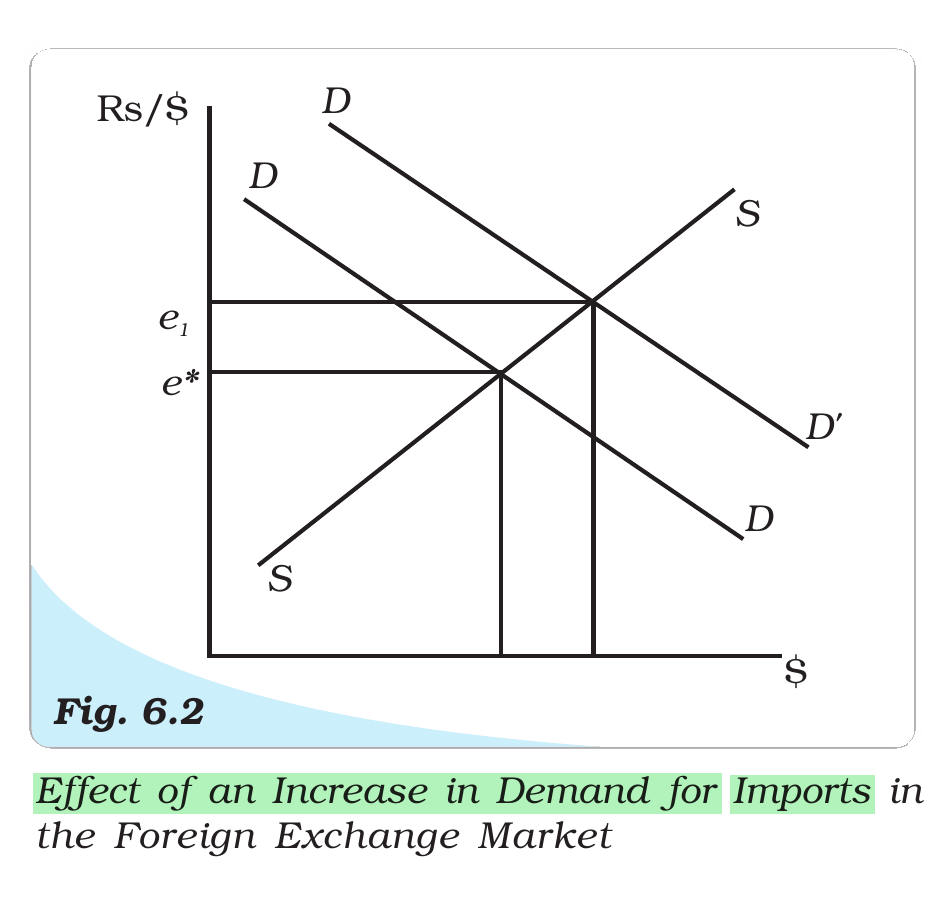
(A) It leads to a shift in the demand curve towards right. — More dollars are now demanded at every exchange rate, so the demand curve for foreign exchange shifts upward and to the right, from DD to D′D′, while the supply of dollars stays the same.
(B) More Rupee needed against a dollar. — At the old rate the demand for dollars exceeds their supply, so the rupee price of a dollar rises until a new equilibrium is reached, for instance from Rs. 50 to Rs. 70 per dollar (e* to e1).
(D) It leads to depreciation of the domestic currency in terms of dollars. — With more rupees paid for each dollar, the rupee has depreciated. (B) and (D) describe the same change from two sides: the rise in the exchange rate is what happens in the market, and depreciation is the name given to that rise, so (B) comes before (D).
Note: A same/similar question was asked in CUET (UG) in the papers below.
| 2026 | 2025 | 2024 | 2023 | 2022 |
| 13-05 S1* 21-05 S1 24-05 S1* | – | – | – | – |
* A similar question.
NCERT (2025-26): “Flexible Exchange Rate … Suppose the demand for foreign goods and services increases (for example, due to increased international travelling by Indians), then as depicted in Fig. 6.2, the demand curve shifts upward and right to the original demand curve. The increase in demand for foreign goods and services result in a change in the exchange rate. The initial exchange rate e0 = 50, which means that we need to exchange Rs 50 for one dollar. At the new equilibrium, the exchange rate becomes e1 = 70, which means that we need to pay more rupees for a dollar now (i.e., Rs 70). It indicates that the value of rupees in terms of dollars has fallen and value of dollar in terms of rupees has risen. Increase in exchange rate implies that the price of foreign currency (dollar) in terms of domestic currency (rupees) has increased. This is called Depreciation of domestic currency (rupees) in terms of foreign currency (dollars).…”
|