CUETMOCK
  • Pricing
  • Mentors
Log inStart freeStart free mocks→

First test, then trust

Try a free CUET mock test.

Join 5,00,000+ students who rehearsed exam day on the exact NTA screen before sitting CUET. On the web and on Android.

Start free mocks →Get the Android app
CUETMOCK

India's #1 CUET Mock Test Platform. Original NCERT-based questions on the exact NTA exam screen — trusted by 5,00,000+ students since CUET 2022.

Get it onGoogle PlayScan to download the CUETMOCK app

Mock tests

  • CUET mock test series
  • Browse all papers
  • Commerce mocks
  • Humanities (Arts) mocks
  • Science mocks
  • Languages & GAT mocks
  • Free practice questions
  • Pricing

Resources

  • CUET exam guide
  • CUET syllabus
  • Universities accepting CUET
  • Expert blogs
  • News & notifications
  • Webinars & counselling
  • CUET score calculator
  • How we estimate your rank
  • FAQs

Company

  • About us
  • Our leadership & team
  • Our toppers
  • Mentors
  • For schools
  • Contact us
  • Terms
  • Privacy
  • Refund policy

Talk to us

+91 7696 6630 56info@cuetmock.comWhatsApp us

Our other platforms

  • JEE Mock — For IIT-JEE aspirants
  • NEET Mock — For NEET aspirants

Newsletter

Exam updates, study material and offers — no spam.

© 2026 NYC Ventures Pvt. Ltd.

701-702, Royal Business Park, Zirakpur, Punjab - 140603

  • Terms of use
  • Privacy policy
  • Refund policy
  • Contact us

iCUETMOCK is an independent preparation platform, not affiliated with the National Testing Agency (NTA). Always check exam details on the official NTA website.

  • Home
  • Mock tests
  • CUET guide
  • Pricing
  • Log in
Home/Practice questions/Economics
EconomicsMicro Economics: Theory of Consumer behaviour

Which of the following combinations are correct about the total expen…

Which of the following combinations are correct about the total expenditure method of measuring elasticity?

A. Total expenditure on a commodity increases with the increase in the price of the commodity then elasticity of demand for that commodity is elastic.
B. Total expenditure on a commodity increases with the increase in the price of the commodity then elasticity of demand for that commodity is inelastic.
C. Demand for that commodity is less responsive to the changes in price of that commodity then total expenditure increases with increase in price.
D. Demand for that commodity is more responsive to the changes in price of that commodity then total expenditure decreases with increase in price.

Choose the correct answer from the options given below:

Answer & explanation+

Correct answer: option 4

The correct answer is Option (4) → B, C and D only

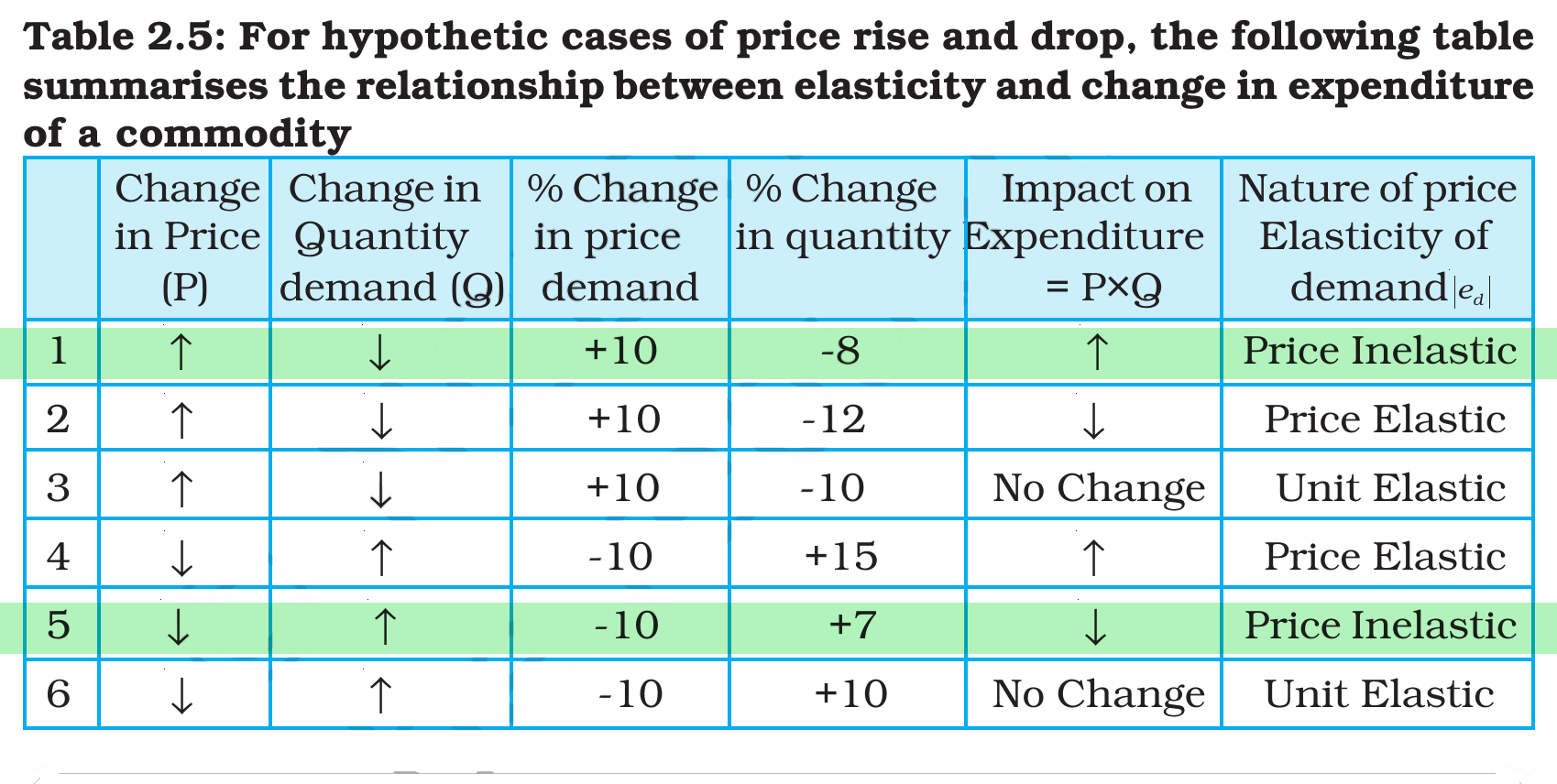
What buyers spend on a good, its total expenditure, is its price times the quantity they buy. When the price rises the quantity falls, so the two pull expenditure in opposite directions, and which change is larger in percentage terms decides the result. The movement of expenditure therefore reveals the price elasticity of demand:

  • Elastic demand (eD > 1): buyers are more responsive; the quantity falls by a larger percentage than the price rises, so expenditure falls when the price rises — it moves opposite to price.

  • Unitary elastic demand (eD = 1): the two changes balance and expenditure stays the same.

  • Inelastic demand (eD < 1): buyers are less responsive; the quantity falls by a smaller percentage than the price rises, so expenditure rises with the price — it moves in the same direction.

A. Total expenditure on a commodity increases with the increase in the price of the commodity then elasticity of demand for that commodity is elastic. Incorrect. Expenditure rising with price is the case of inelastic demand, not elastic.

B. Total expenditure on a commodity increases with the increase in the price of the commodity then elasticity of demand for that commodity is inelastic. Correct. Price and expenditure move in the same direction, the mark of inelastic demand.

C. Demand for that commodity is less responsive to the changes in price of that commodity then total expenditure increases with increase in price. Correct. Less responsive demand is inelastic, so a rise in price raises total expenditure.

D. Demand for that commodity is more responsive to the changes in price of that commodity then total expenditure decreases with increase in price. Correct. More responsive demand is elastic, so expenditure falls as the price rises.


NCERT (2025-26): “2.6.3 Elasticity and Expenditure … The expenditure on a good is equal to the demand for the good times its price. Often it is important to know how the expenditure on a good changes as a result of a price change. The price of a good and the demand for the good are inversely related to each other. Whether the expenditure on the good goes up or down as a result of an increase in its price depends on how responsive the demand for the good is to the price change.…

…The expenditure on the good would change in the opposite direction as the price change if and only if the percentage change in quantity is greater than the percentage change in price, ie if the good is price-elastic (see rows 2 and 4 in table 2.5). The expenditure on the good would change in the same direction as the price change if and only if the percentage change in quantity is less than the percentage change in price, i.e., if the good is price inelastic (see rows 1 and 5 in table 2.5).…”

NCERT extract

Advertisement

Practise more on Micro Economics: Theory of Consumer behaviour

Chapter-wise mocks on the real NTA exam screen, with solutions and your rank. Your first mocks are free.

Start free mocks →

Advertisement

Next questions

  1. A person has been bitten by a snake, doctor immediately gives him an injection which consists of:Biology · Human Health and Disease
  2. Which school flourished under the patronage of Rao Chattar Sal and Rao Bhao Singh?Fine Arts · The Rajasthani Schools of Painting
  3. From the given series, which are in Arithmetic Progression?A. 7, 14, 21, 28, ...B. 9, 17, 28, 40, ...C. 3, 8, 13, 18, ...D. 1, −1, −3, −5,…General Aptitude Test · Quantitative Reasoning
  4. If a matrix A= […] is expressed as the sum of a symmetric matrix P and a skew symmetric matrix Q, then symmetric matrix P will beMaths. Section A · Matrices
  5. If a container contains ‘ t ’ units of a particular liquid. Out of which ‘ s ’ units are taken out and replaced by water. Then after p-1 op…Applied Maths. Section B2 · Numbers, Quantification and Numerical Applications
  6. Which one of the following techniques serve the purpose of early diagnosis of diseases?Biology · Biotechnology and its Applications
  7. Match List-I with List-IIList-IList-II(A) Lender of last resort(I) 1/Cash reserve ratio(B) Money multiplier(II) Buying and selling governme…Economics · Macro Economics: Money and Banking
  8. If all people in the economy increase the proportion of income they save, then total savings in the economy will not increase; it will eith…Economics · Macro Economics: Determination of Income and Employment
  9. Match the LIST-I with LIST-IILIST-ILIST-IITypes of immunity barriersExamplesA. Physical barriersI. Polymorpho-nuclear leukocytesB. Physiolo…Biology · Human Health and Disease
  10. Which of the following complexes will not exhibit optical isomerism?Chemistry · Inorganic: Coordination Compounds