Which of the following complexes will not exhibit optical isomerism?
Answer & explanation
Correct answer: option 3
The correct answer is Option (3) → trans-[PtCl2(en)2]2+
A complex shows optical isomerism when it is chiral: its mirror image cannot be superimposed on it. A complex that has a plane of symmetry is never chiral. In octahedral complexes, chirality is common when didentate ligands such as en or ox are present:
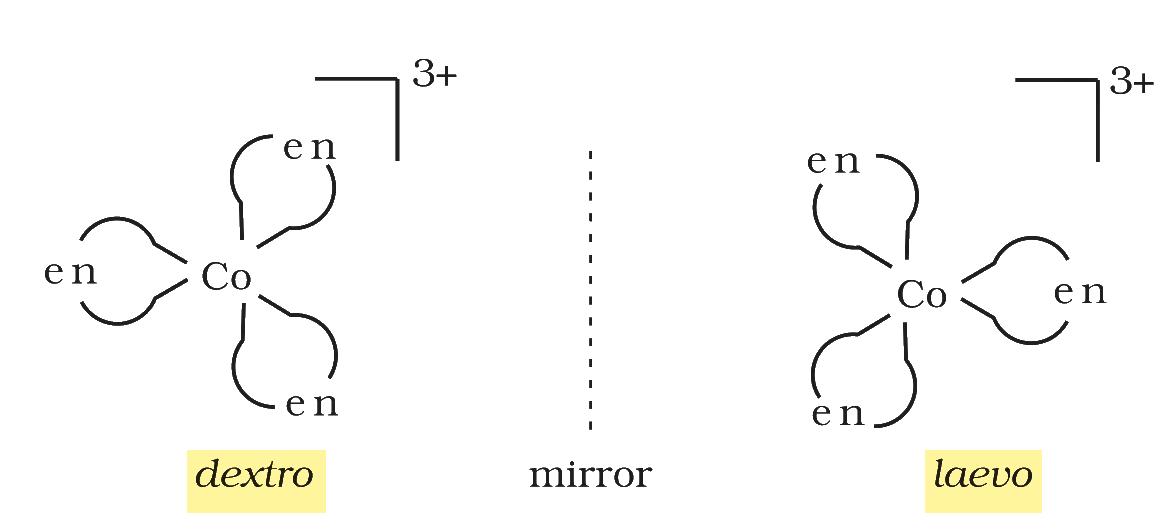
[M(AA)3]: always optically active.
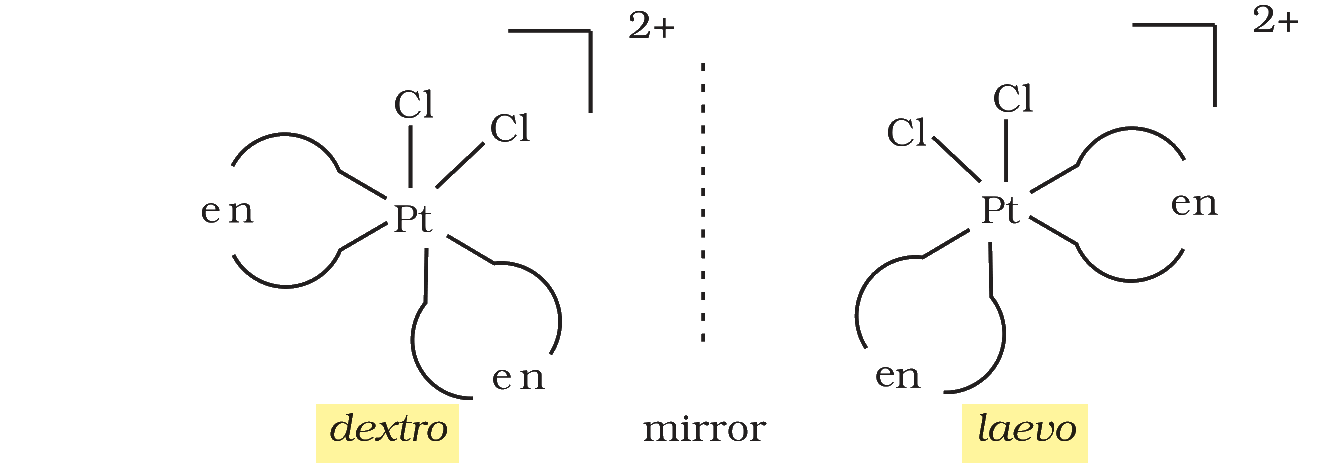
[M(AA)2X2]: the cis isomer is optically active; the trans isomer is not.
Option (1) cis-[PtCl2(en)2]2+ — Shows optical isomerism. The two \( \ce{Cl^{-}} \) ions are adjacent, the complex has no plane of symmetry, and it exists as two enantiomers (d and l).
Option (2) [Co(en)3]3+ — Shows optical isomerism. Three en rings arranged like a propeller can twist in two opposite senses, giving two non-superimposable mirror images.
Option (3) trans-[PtCl2(en)2]2+ — Does not show optical isomerism. The two \( \ce{Cl^{-}} \) ions sit opposite each other, and the two en rings lie in one plane between them. That plane is a plane of symmetry, so the mirror image is the same complex.
Option (4) cis-[CrCl2(C2O4)2]3− — Shows optical isomerism. It is also a cis-[M(AA)2X2] complex, with oxalate as the didentate ligand, so it is chiral.
NCERT (2026-27 edition):
Optical Isomerism