Identify the factor, which does not affect Hardy-Weinberg equilibrium.
Answer & explanation
Correct answer: option 2
The correct answer is Option (2) → Co-dominance
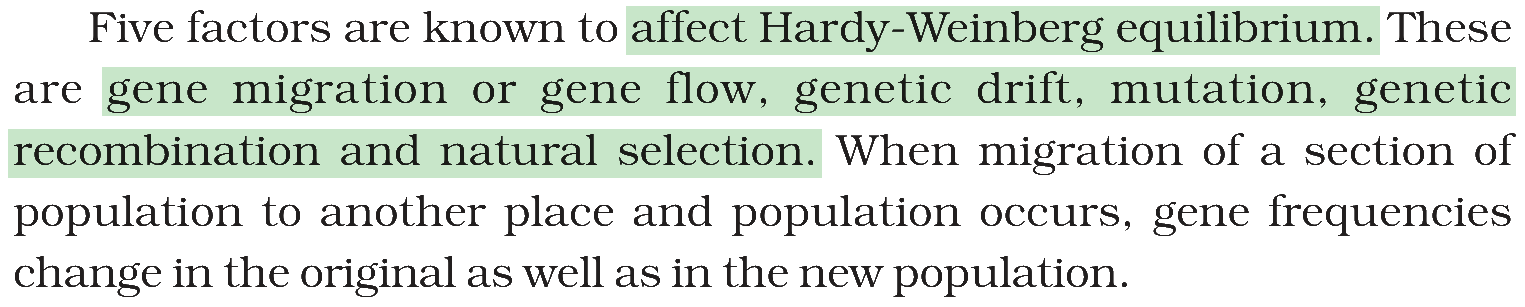
The Hardy-Weinberg principle says that the frequencies of alleles in a population stay constant from generation to generation. The gene pool stays the same, and this is called genetic equilibrium. A change in allele frequency disturbs the equilibrium, and that change is evolution. Five factors affect the equilibrium: gene migration (gene flow), genetic drift, mutation, genetic recombination and natural selection.
(1) Gene migration — Affects Hardy-Weinberg equilibrium. When individuals move into or out of a population, they add or remove alleles, so the frequencies change.
(2) Co-dominance — Does not affect Hardy-Weinberg equilibrium. It tells how two alleles are expressed together in a heterozygote, as in the AB blood group. It does not change how many copies of each allele are in the population.
(3) Genetic drift — Affects Hardy-Weinberg equilibrium. It is a change in allele frequency that happens by chance.
(4) Natural selection — Affects Hardy-Weinberg equilibrium. Alleles that give a better chance of survival and reproduction become more frequent.
NCERT Extract:
Hardy-Weinberg Principle – …