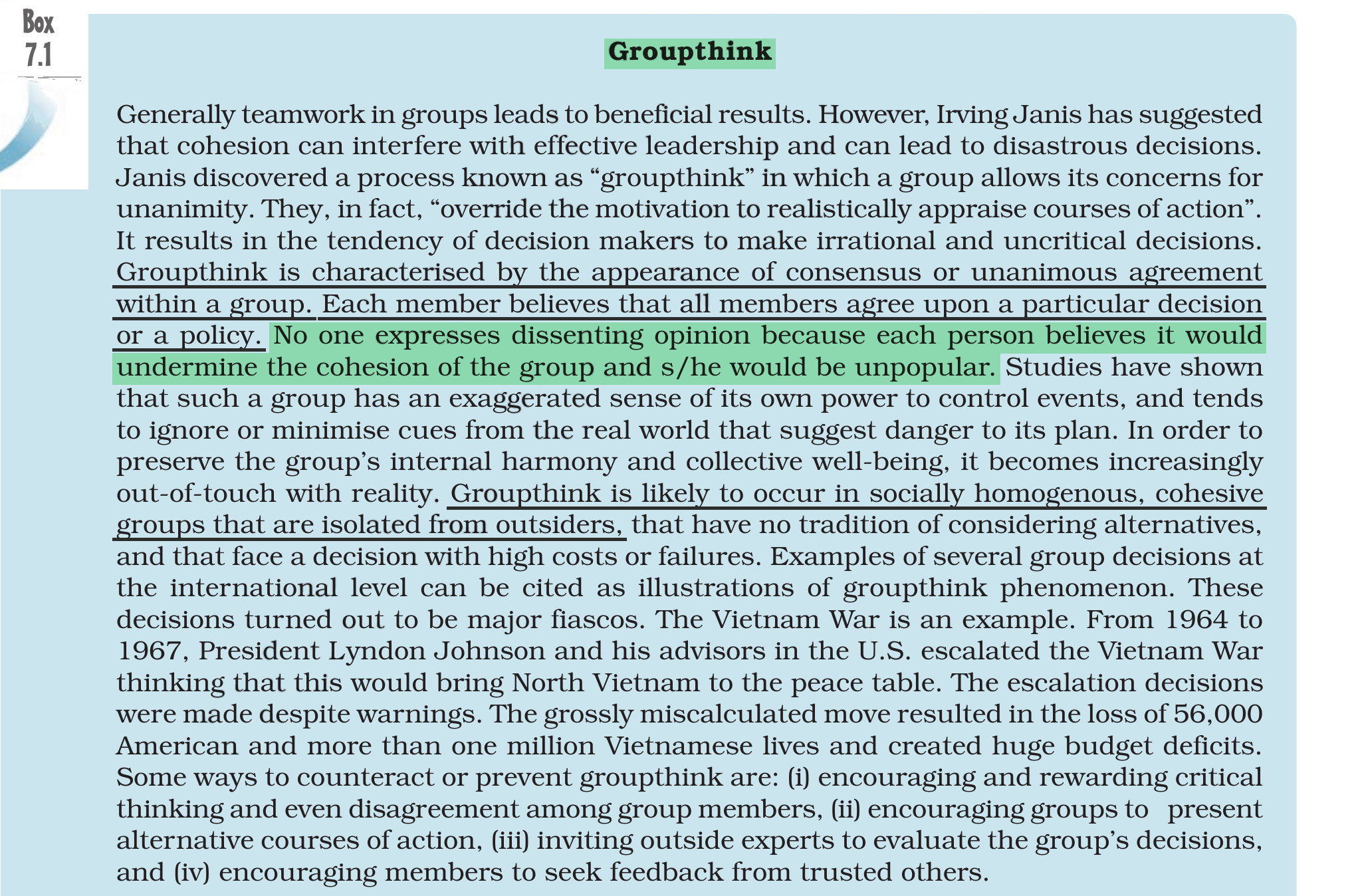
Generally, teamwork in groups leads to beneficial results. Rayan, working at an automobile company, suggested that extreme cohesion can interfere with effective leadership and can lead to disastrous decisions. This process is termed as “groupthink” in which a group allows its concerns for unanimity. They, in fact, “override the motivation to realistically appraise courses of action”. It results in the tendency of decision maker to make irrational decisions. Studies have shown that such a group has an exaggerated sense of its own power to control events and tends to ignore and minimise outside cues from real world in order to preserve their internal harmony and collective well-being.
Groupthink is NOT characterised by:
Answer & explanation
Correct answer: option 2
The correct answer is Option (2) → Greater expression of dissent
Option (1) Unanimous agreement within a group — A feature of groupthink (Incorrect). Groupthink is characterised by the appearance of consensus or unanimous agreement within the group.
Option (2) Greater expression of dissent — Not a feature of groupthink (Correct). In groupthink no one expresses a dissenting opinion, because each person believes it would undermine the cohesion of the group and make her or him unpopular. Encouraging disagreement is in fact one of the ways to prevent groupthink.
Option (3) It is likely to occur in a cohesive group — A feature of groupthink (Incorrect). Groupthink is likely in socially homogenous, cohesive groups isolated from outsiders; it is cohesion that silences doubts.
Option (4) All members agree upon a particular decision — A feature of groupthink (Incorrect). Each member believes that all members agree upon a particular decision or policy, which is the appearance of consensus.
NCERT: Psychology — Chapter 7: Social Influence and Group Processes, Box 7.1 (2025-26)
|