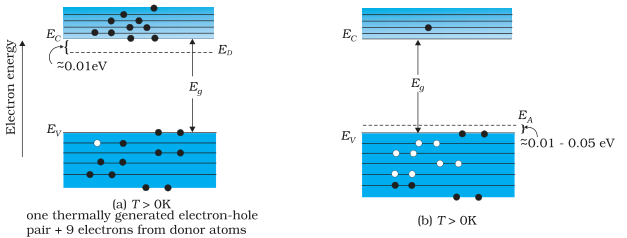
When Germanium (Ge) is doped with Antimony (Sb), an additional energy state is introduced in the energy band diagram of this extrinsic semiconductor, which of the following statements is correct in this regard?
Answer & explanation
Correct answer: option 3
The correct answer is Option (3) → The donor energy level ED is slightly below the bottom EC of the conduction band.
Antimony is pentavalent: four valence electrons bond with neighbouring germanium atoms and the fifth is loosely bound. Sb is a donor impurity (n-type), and its extra electron occupies a donor level \( E_D \) about 0.01 eV below the conduction band.
Option (1) The donor energy level ED is slightly above the top EV of the valence band. — Incorrect. The donor level lies near the conduction band.
Option (2) The acceptor energy level EA is slightly above the top EV of the valence band. — Incorrect. Acceptor levels come from trivalent impurities; antimony is pentavalent.
Option (3) The donor energy level ED is slightly below the bottom EC of the conduction band. — Correct. A small thermal energy lifts this electron into the conduction band.
Option (4) The acceptor energy level EA is slightly below the bottom EC of the conduction band. — Incorrect. Antimony creates no acceptor level.
NCERT (2026-27):
Extrinsic Semiconductor – “… In the case of extrinsic semiconductors, additional energy states due to donor impurities (\( E_D \)) and acceptor impurities (\( E_A \)) also exist. In the energy band diagram of n-type Si semiconductor, the donor energy level \( E_D \) is slightly below the bottom \( E_C \) of the conduction band and electrons from this level move into the conduction band with very small supply of energy. … Similarly, for p-type semiconductor, the acceptor energy level \( E_A \) is slightly above the top \( E_V \) of the valence band as shown in Fig. 14.9(b).”