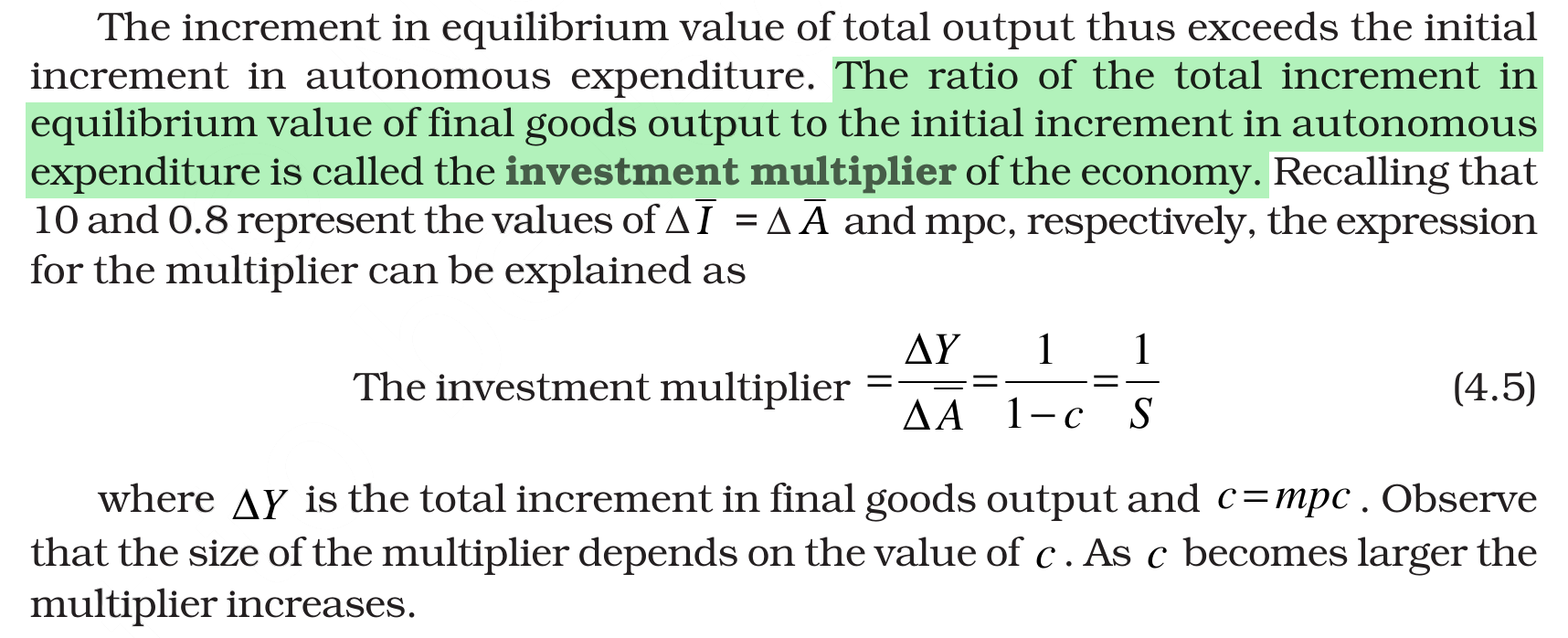
The ratio of the total increment in equilibrium value of final goods output to the initial increment in autonomous expenditure is called …………
Answer & explanation
Correct answer: option 2
The correct answer is Option (2) → Investment multiplier
Suppose firms spend Rs. 10 crore more on investment. That money becomes someone’s income; part of it is spent and becomes another person’s income, and so on, round after round, so output rises by more than the first Rs. 10 crore. The ratio of the total increment in equilibrium output to the initial increment in autonomous expenditure is the investment multiplier:
Investment multiplier = ΔY ÷ ΔA = 1 ÷ (1 − c) = 1 ÷ s
Here c is the marginal propensity to consume and s the marginal propensity to save: the larger the share of extra income that is spent, the larger the multiplier. If c = 0.8, the multiplier is 1 ÷ 0.2 = 5, and the Rs. 10 crore of investment raises output by Rs. 50 crore.
Why the other options are incorrect
Option (1) Autonomous Investment. — Incorrect. Autonomous investment is investment that does not depend on income. Its increase is the denominator of the ratio, the initial increment, not the ratio itself.
Option (3) Marginal propensity to consume — Incorrect. The MPC is the change in consumption per unit change in income, ΔC/ΔY. It decides the size of the multiplier but is a different ratio, which always lies between 0 and 1.
Option (4) Marginal propensity to save — Incorrect. The MPS is the change in saving per unit change in income, ΔS/ΔY. The multiplier is its reciprocal, 1/MPS, not the MPS itself.
Note: A same/similar question was asked in CUET (UG) in the papers below.
| 2026 | 2025 | 2024 | 2023 | 2022 |
| 13-05 S1* 21-05 S1 | 13-05 S2* 27-05 S2* 29-05 S2* 30-05 S2* | – | 29-05 S1* 22-06 S3* | – |
* A similar question.
NCERT: Introductory Macroeconomics — Chapter 4: Determination of Income and Employment (2025-26)
|