
Which of the following relations does not represent colligative property?
Answer & explanation
Correct answer: option 3
The correct answer is Option (3) → \( p_{total}=p_1^0+(p_2^0-p_1^0)x_2 \)
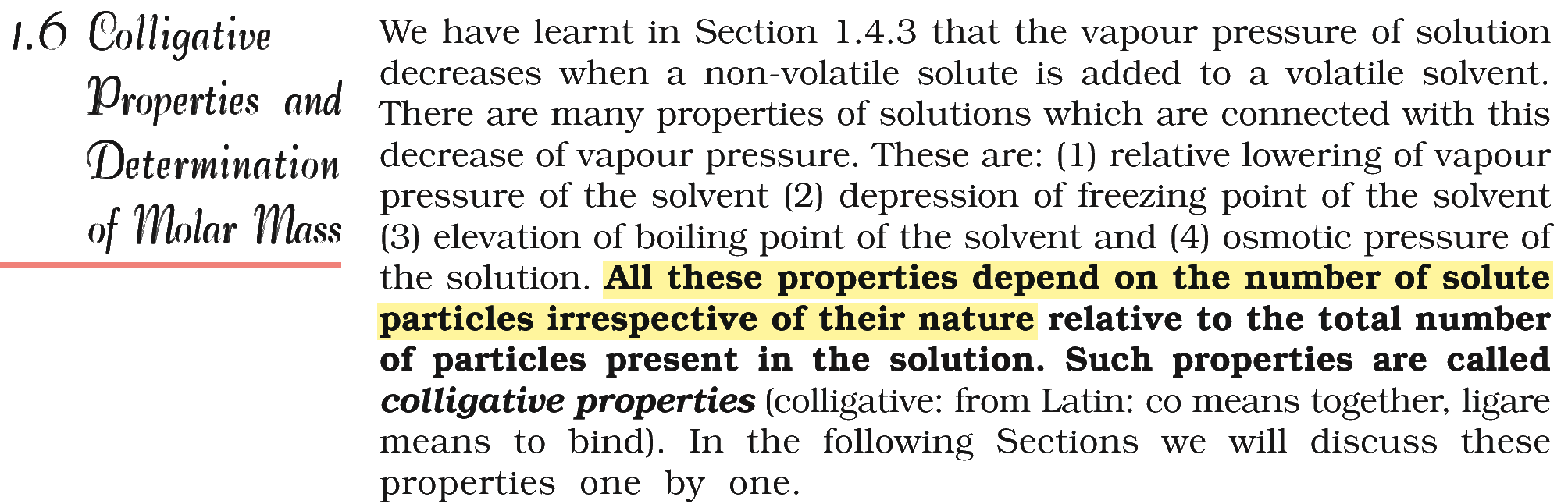
Colligative properties depend only on the number of solute particles, not on their nature, so each of their relations is proportional to the molality m or the molarity c of the solute.
Option (1) \( \Delta T_b=K_b m \) — A colligative property relation (elevation of boiling point). ΔTb depends only on the molality of the solute.
Option (2) \( \Delta T_f=K_f m \) — A colligative property relation (depression of freezing point). ΔTf depends only on the molality of the solute.
Option (3) \( p_{total}=p_1^0+(p_2^0-p_1^0)x_2 \) — Not a colligative property relation (Raoult’s law, total vapour pressure of two volatile liquids). It gives the total vapour pressure of a mixture of two volatile liquids, which depends on the vapour pressures of the pure components, i.e. on their nature.
Option (4) \( \pi=cRT \) — A colligative property relation (osmotic pressure). The osmotic pressure depends only on the molar concentration of the solute.
NCERT (2026-27 edition):
Colligative Properties and Determination of Molar Mass
Vapour Pressure of Liquid-Liquid Solutions – “Let us consider a binary solution of two volatile liquids and denote the two components as 1 and 2. … Let the total vapour pressure at this stage be ptotal and p1 and p2 be the partial vapour pressures of the two components 1 and 2 respectively. … Substituting the values of p1 and p2, we get
\( \displaystyle p_{total}=x_1p_1^0+x_2p_2^0=p_1^0+(p_2^0-p_1^0)x_2 \)”