
The figure shows the structures of methanol, phenol and methoxymethane.
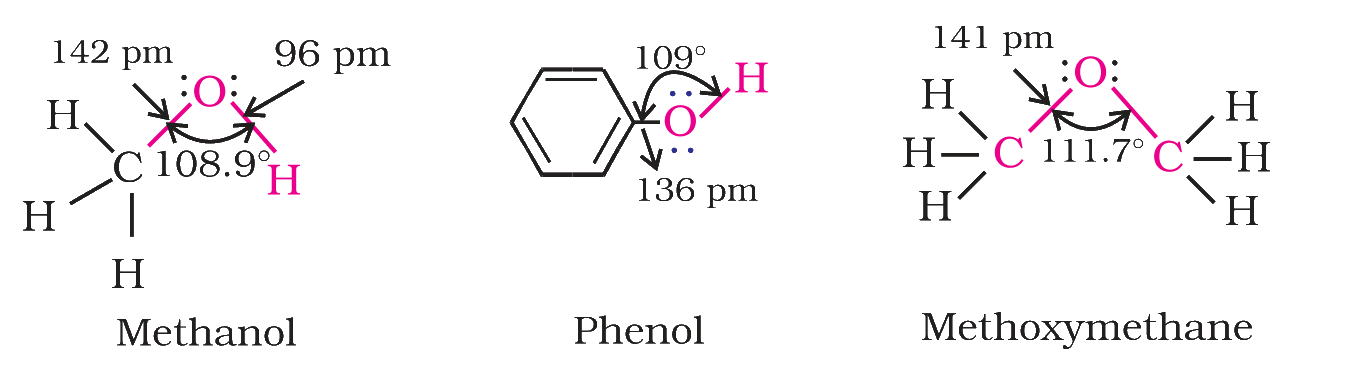
The C–O–H bond angle in methanol, shown in the figure, differs slightly from the tetrahedral angle (109°28′). This is due to:
Answer & explanation
Correct answer: option 3
The correct answer is Option (3) → repulsion between the unshared electron pairs of oxygen
In methanol the oxygen is sp3 hybridised and carries two bond pairs and two unshared (lone) pairs. The figure gives the C–O–H angle as 108.9°, a little below 109°28′. The two lone pairs repel the bond pairs more strongly than bond pairs repel one another, so they push the C–O and O–H bonds slightly closer together.
Why the other options are incorrect
Option (1) repulsion between the two bulky groups attached to oxygen — Incorrect. Repulsion between two bulky groups opens the angle, as in methoxymethane (111.7°); the methanol angle is smaller than tetrahedral, and one group on its oxygen is a small hydrogen atom.
Option (2) partial double bond character of the carbon–oxygen bond — Incorrect. This explains the shorter C–O bond of phenol (136 pm); it does not decide the bond angle of methanol.
Option (4) sp2 hybridisation of the oxygen atom — Incorrect. The oxygen of an alcohol is sp3 hybridised; an sp2 atom would give angles near 120°, not just below 109°28′.
NCERT (2026-27 edition):
7.3 Structures of Functional Groups – “In alcohols, the oxygen of the –OH group is attached to carbon by a sigma (σ) bond formed by the overlap of a sp3 hybridised orbital of carbon with a sp3 hybridised orbital of oxygen. … The bond angle in alcohols is slightly less than the tetrahedral angle (109°-28′). It is due to the repulsion between the unshared electron pairs of oxygen.”
Fig. 7.1: Structures of methanol, phenol and methoxymethane