
Observe the diagram and answer the question.
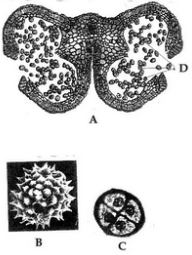
Identify the correct statement from the following:
Answer & explanation
Correct answer: option 3
The correct answer is Option (3) → Pollen banks contain stored pollen in liquid nitrogen at -196°C
Option (1) Pollen of rice lose viability within ten minutes of their release — Incorrect. Rice pollen loses viability within 30 minutes, not ten.
Option (2) Viability of pollen depend upon the stage at which they are released — Incorrect. Viability depends on temperature and humidity, not on the stage of release.
Option (3) Pollen banks contain stored pollen in liquid nitrogen at -196°C — Correct. Pollen can be kept for years in liquid nitrogen at −196 °C.
Option (4) Pollen banks contains stored pollen in liquid nitrogen at -196°F — Incorrect. NCERT gives the temperature as −196 °C, the temperature of liquid nitrogen. −196 °F is a different, much warmer temperature, at which nitrogen would not be a liquid.
NCERT Extract:
Stamen, Microsporangium and Pollen Grain – “… In some cereals such as rice and wheat, pollen grains lose viability within 30 minutes of their release, and in some members of Rosaceae, Leguminoseae and Solanaceae, they maintain viability for months. You may have heard of storing semen/ sperms of many animals including humans for artificial insemination. It is possible to store pollen grains of a large number of species for years in liquid nitrogen (–196°C). Such stored pollen can be used as pollen banks, similar to seed banks, in crop breeding programmes.”