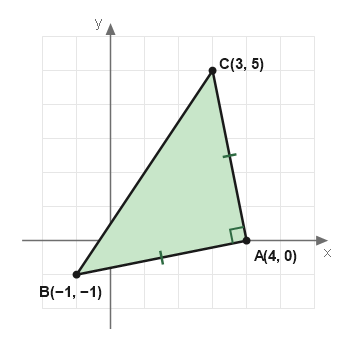
A triangle with vertices (4, 0), (-1, -1) and (3, 5) is:
Answer & explanation
Correct answer: option 1
The correct answer is Option (1) → Isosceles and right angled
Find the three sides with the distance formula. Two equal sides make the triangle isosceles; if the squares of two sides add up to the square of the third, it is right angled (converse of Pythagoras’ theorem).
With A(4, 0), B(−1, −1) and C(3, 5):
Side AB: \(AB^{2}=(4+1)^{2}+(0+1)^{2}=26\)
Side AC: \(AC^{2}=(4-3)^{2}+(0-5)^{2}=26\)
Side BC: \(BC^{2}=(3+1)^{2}+(5+1)^{2}=52\)
\(AB=AC\): isosceles
\(AB^{2}+AC^{2}=26+26=52=BC^{2}\): right angle at A