CUETMOCK
  • Pricing
  • Mentors
Log inStart freeStart free mocks→

First test, then trust

Try a free CUET mock test.

Join 5,00,000+ students who rehearsed exam day on the exact NTA screen before sitting CUET. On the web and on Android.

Start free mocks →Get the Android app
CUETMOCK

India's #1 CUET Mock Test Platform. Original NCERT-based questions on the exact NTA exam screen — trusted by 5,00,000+ students since CUET 2022.

Get it onGoogle PlayScan to download the CUETMOCK app

Mock tests

  • CUET mock test series
  • Browse all papers
  • Commerce mocks
  • Humanities (Arts) mocks
  • Science mocks
  • Languages & GAT mocks
  • Free practice questions
  • Pricing

Resources

  • CUET exam guide
  • CUET syllabus
  • Universities accepting CUET
  • Expert blogs
  • News & notifications
  • Webinars & counselling
  • CUET score calculator
  • How we estimate your rank
  • FAQs

Company

  • About us
  • Our leadership & team
  • Our toppers
  • Mentors
  • For schools
  • Contact us
  • Terms
  • Privacy
  • Refund policy

Talk to us

+91 7696 6630 56info@cuetmock.comWhatsApp us

Our other platforms

  • JEE Mock — For IIT-JEE aspirants
  • NEET Mock — For NEET aspirants

Newsletter

Exam updates, study material and offers — no spam.

© 2026 NYC Ventures Pvt. Ltd.

701-702, Royal Business Park, Zirakpur, Punjab - 140603

  • Terms of use
  • Privacy policy
  • Refund policy
  • Contact us

iCUETMOCK is an independent preparation platform, not affiliated with the National Testing Agency (NTA). Always check exam details on the official NTA website.

  • Home
  • Mock tests
  • CUET guide
  • Pricing
  • Log in
Home/Practice questions/History
HistoryAncient India: Kinship, Caste and Class

Arrange the following major textual traditions in chronological order…

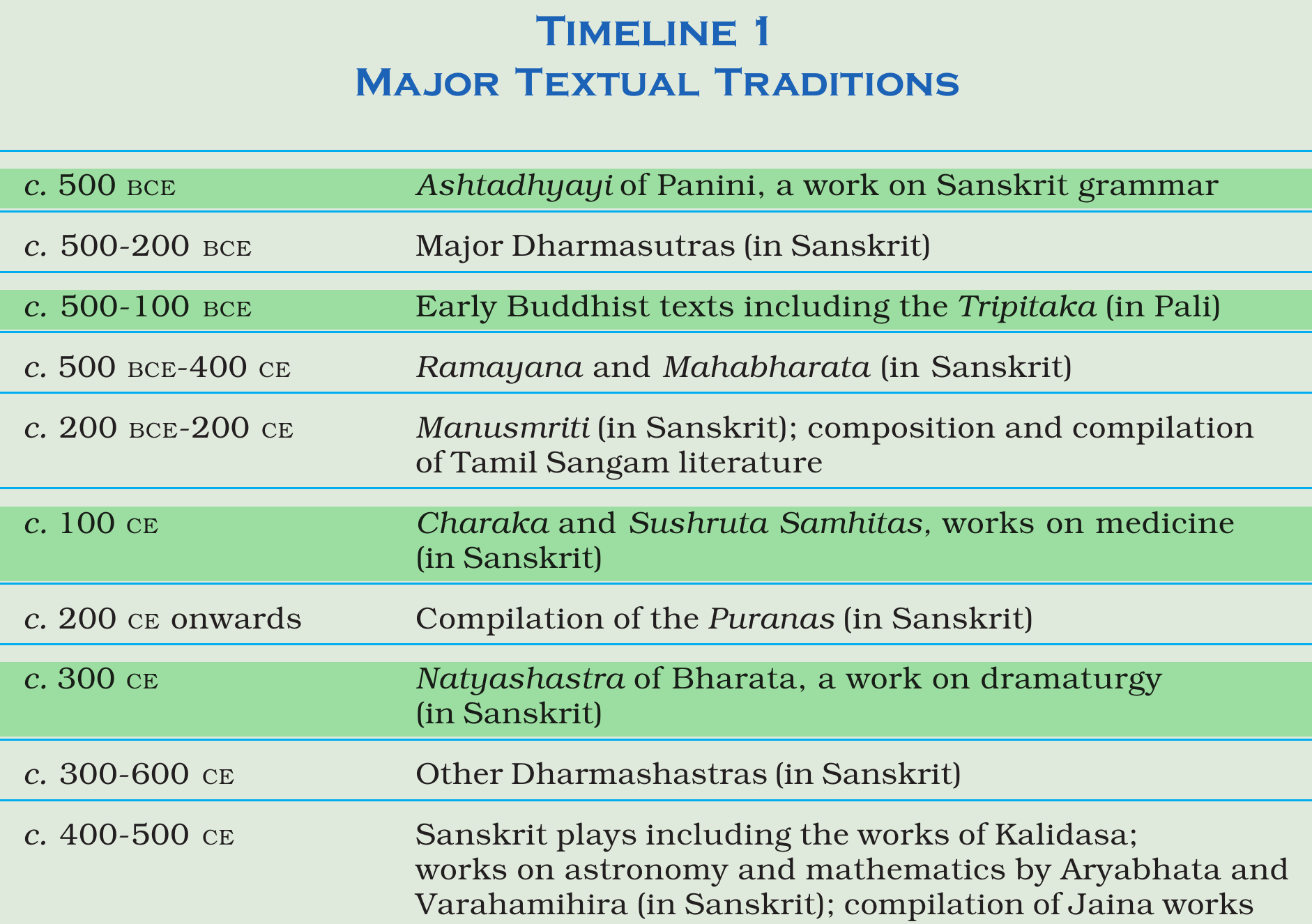
Arrange the following major textual traditions in chronological order:

A. Charaka and Sushruta Samhitas

B. Ashtadhyayi of Panini

C. Natyashastra of Bharata

D. Early Buddhist texts, including the Tripitaka

Choose the correct answer from the options given below:

Answer & explanation+

Correct answer: option 3

The correct answer is Option (3) → B, D, A, C

(B) Ashtadhyayi of Panini — c. 500 BCE. Panini’s work on Sanskrit grammar is the earliest of the four.

(D) Early Buddhist texts, including the Tripitaka — c. 500-100 BCE. The Tripitaka, the ‘three baskets’ of the Buddha’s teachings, was written in Pali.

(A) Charaka and Sushruta Samhitas — c. 100 CE. These are the great early works on medicine, written in Sanskrit.

(C) Natyashastra of Bharata — c. 300 CE. Bharata’s work on dramaturgy is the latest of the four.


NCERT: Themes in Indian History Part I — Chapter 3: Kinship, Caste and Class (2025-26)

NCERT extract

Advertisement

Practise more on Ancient India: Kinship, Caste and Class

Chapter-wise mocks on the real NTA exam screen, with solutions and your rank. Your first mocks are free.

Start free mocks →

Advertisement

Next questions

  1. In Verhulst-Pearl logistic growth equation – dN/dt = rN ≤ft((K - N)/K) 'r' denotes:Biology · Organisms and Populations
  2. 'दूर तुम से हूँ अखंड सुहागिनी भी हूँ' से आशय होगा:Hindi · Comprehension - (Poetry / Literary)
  3. The electric field at a point distance r away from a uniformly charged infinite plane sheet isPhysics · Electric Charges and Fields
  4. A number when increased by 23% becomes 2337. The number is:General Aptitude Test · Numerical Ability
  5. What is the glycosidic linkage in sucrose?Chemistry · Organic: Biomolecules
  6. Complete the following sentence with the correct option : Lalit has gone to the bank to get ________ money.English · Grammar: Determiner
  7. Select the most appropriate synonym of the given word. ANTHOLOGYEnglish · Synonyms
  8. Constituent Assembly members in 1947 often recalled the riots while discussing how authority should be shared between the Union and the sta…History · Modern India: Framing the Constitution
  9. How many codons with 'A' at second position code for amino acids?Biology · Molecular Basis of Inheritance
  10. What is the elasticity of demand called if it measures the responsiveness of the quantity demanded of a good, to change in price of other g…Economics · Micro Economics: Theory of Consumer behaviour