
What is the glycosidic linkage in sucrose?
Answer & explanation
Correct answer: option 1
The correct answer is option 1. α-1,β-2-glycosidic linkage.
Sucrose is a disaccharide, meaning it's a sugar molecule formed by linking two simpler sugar units called monosaccharides. In sucrose's case, these monosaccharides are \(\alpha \)-D-glucose and \(\beta \)-D-fructose.
The linkage between these two units is a specific type of covalent bond called a glycosidic linkage. This bond forms between the hydroxyl group \((OH)\) on one sugar and the anomeric carbon \((C_1)\) of another sugar. The anomeric carbon is special because it can exist in two different configurations, alpha \((\alpha )\) or beta \((\beta )\), which affects the 3D structure of the sugar.
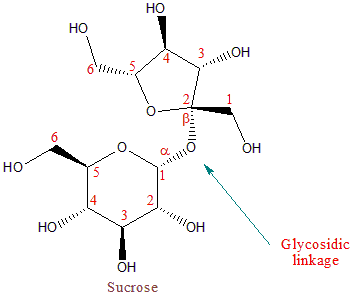
Here's a breakdown of the glycosidic linkage in sucrose:
\(\alpha -1,\beta -2\):
\(\alpha \): This refers to the configuration of the anomeric carbon \((C_1)\) in the \(alpha \)-D-glucose unit.
\(1\): This indicates that the glycosidic bond forms between the \(C_1\) of the \(\alpha \)-D-glucose unit and...
\(\beta \): This refers to the configuration of the anomeric carbon \((C_1)\) in the \(\beta \)-D-fructose unit.
This specific \(\alpha -1,\beta -2\) linkage is unique to sucrose. It's important because it affects the properties of sucrose compared to other disaccharides like lactose or maltose, which have different glycosidic linkages.
Here are some consequences of the \(\alpha -1,\beta -2\) linkage in sucrose:
Non-reducing sugar: Because both the C1 of glucose and C2 of fructose are involved in the bond, neither sugar has a free anomeric carbon. Free anomeric carbons are necessary for a sugar to react with other molecules, so sucrose cannot act as a reducing sugar (a type of sugar that can participate in certain chemical reactions).
Sweetness: The \(\alpha -1,\beta -2\) linkage contributes to the sweetness of sucrose.