
Which one of the given groups of structures are haploid?
Answer & explanation
Correct answer: option 4
The correct answer is Option (4) → Spermatids, spermatozoa, secondary spermatocytes
In adults, each testis is oval in shape, with a length of about 4 to 5 cm and a width of about 2 to 3 cm. The testis is covered by a dense covering. Each testis has about 250 compartments called testicular lobules. Each lobule contains one to three highly coiled seminiferous tubules in which sperms are produced. Each seminiferous tubule is lined on its inside by two types of cells called male germ cells (spermatogonia) and Sertoli cells. The male germ cells undergo meiotic divisions finally leading to sperm formation, while Sertoli cells provide nutrition to the germ cells. The regions outside the seminiferous tubules called interstitial spaces, contain small blood vessels and interstitial cells or Leydig cells. Leydig cells synthesise and secrete testicular hormones called androgens.
The primary sex organs – the testis in the males produce gametes, i.e, sperms by the process called gametogenesis.
In testis, the immature male germ cells (spermatogonia) produce sperms by spermatogenesis that begins at puberty.
The spermatogonia (sing. spermatogonium) present on the inside wall of seminiferous tubules multiply by mitotic division and increase in numbers.
Each spermatogonium is diploid and contains 46 chromosomes. Some of the spermatogonia called primary spermatocytes periodically undergo meiosis.
A primary spermatocyte completes the first meiotic division (reduction division) leading to formation of two equal, haploid cells called secondary spermatocytes, which have only 23 chromosomes each.
The secondary spermatocytes undergo the second meiotic division to produce four equal, haploid spermatids. But a single secondary spermatocyte will produce only 2 sperms.The spermatids are transformed into spermatozoa (sperms) by the process called spermiogenesis.
After spermiogenesis, sperm heads become embedded in the Sertoli cells, and are finally released from the seminiferous tubules by the process called spermiation.
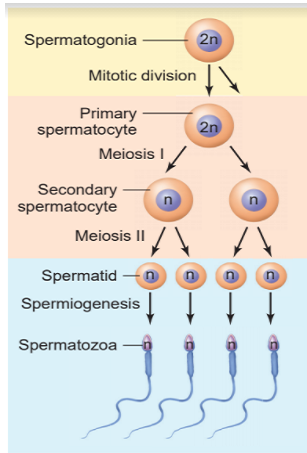
spermatogenesis