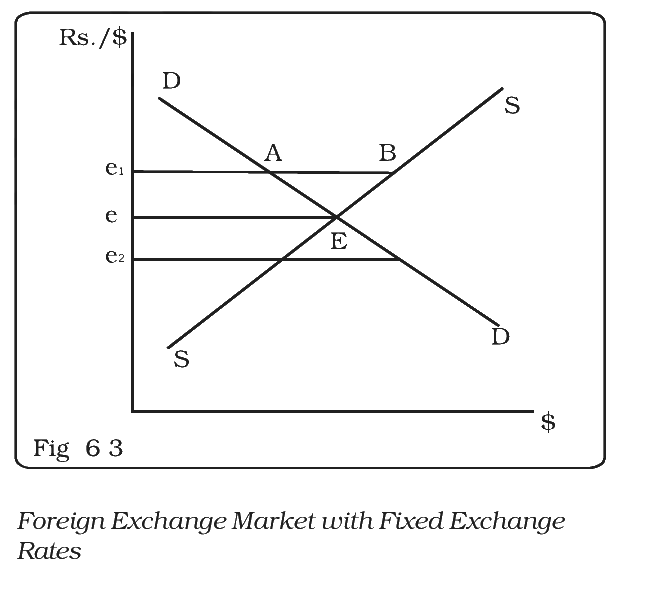
Under a fixed exchange rate system, read the following chain of events:
(A) The government fixes the exchange rate at e2, below the market-determined rate.
(B) There is an excess demand for dollars in the foreign exchange market.
(C) ______
(D) If it fails to do so, a black market for dollars may come up.
Which of the following fills the blank (C)?
Answer & explanation
Correct answer: option 4
The correct answer is Option (4) → The government draws on its past holdings of dollars to meet the excess demand.
At e2 the rupee is kept dearer than the market rate, so more dollars are demanded than supplied. To hold the rate, the government must supply dollars from its past holdings. If it cannot, people trade dollars outside the official market.
Buying dollars to absorb an excess supply fits a rate fixed above the market rate. Letting the market raise the rate would end the fixed system. Revaluing the rupee would lower the rate further and only widen the excess demand.
NCERT (2026-27): “Fixed Exchange Rates … On the other hand if the goverment was to set an exchange rate at a level such as e2, there would be an excess demand for dollars in the foreign exchange market. To meet this excess demand for dollars, the government would have to withdraw dollars from its past holdings of dollars. If it fails to do so, a black market for dollars may come up. …”
|