Which of the following factors can influence Hardy-Weinberg equilibrium?
(A) Natural selection
(B) Genetic recombination
(C) Gene flow
(D) Mutation
Answer & explanation
Correct answer: option 2
The correct answer is Option (2) → (A), (B), (C) and (D) only
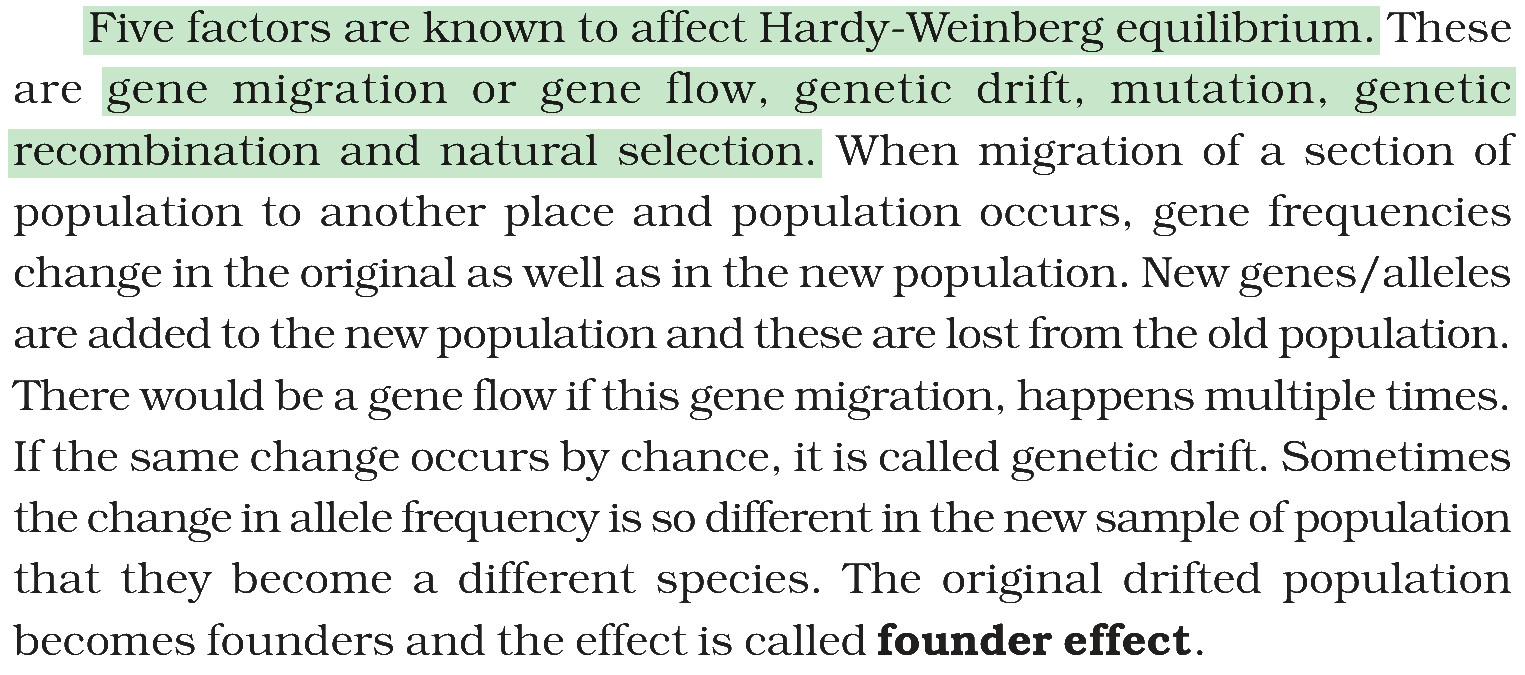
The Hardy-Weinberg principle says that allele frequencies in a population stay constant from generation to generation. This state is called genetic equilibrium. Any factor that changes the allele frequencies disturbs it, and such a change is evolution.
(A) Natural selection — Correct. Individuals with useful variations survive and leave more offspring. So their alleles become more common in the next generation.
(B) Genetic recombination — Correct. Crossing over and the independent assortment of chromosomes during gamete formation produce new combinations of alleles. This variation changes what is passed on.
(C) Gene flow — Correct. When individuals move from one population to another, alleles are added to the new population and lost from the old one. This movement is gene migration; repeated many times it is gene flow.
(D) Mutation — Correct. A mutation is a change in the DNA. It creates new alleles and so changes the allele frequencies.
Note: The same question was also asked in CUET (UG) 2025 on 30-05-2025 (Slot 1), and a similar question in CUET (UG) 2025 on 22-05-2025 (Slot 2).
NCERT Extract:
Hardy-Weinberg Principle – …