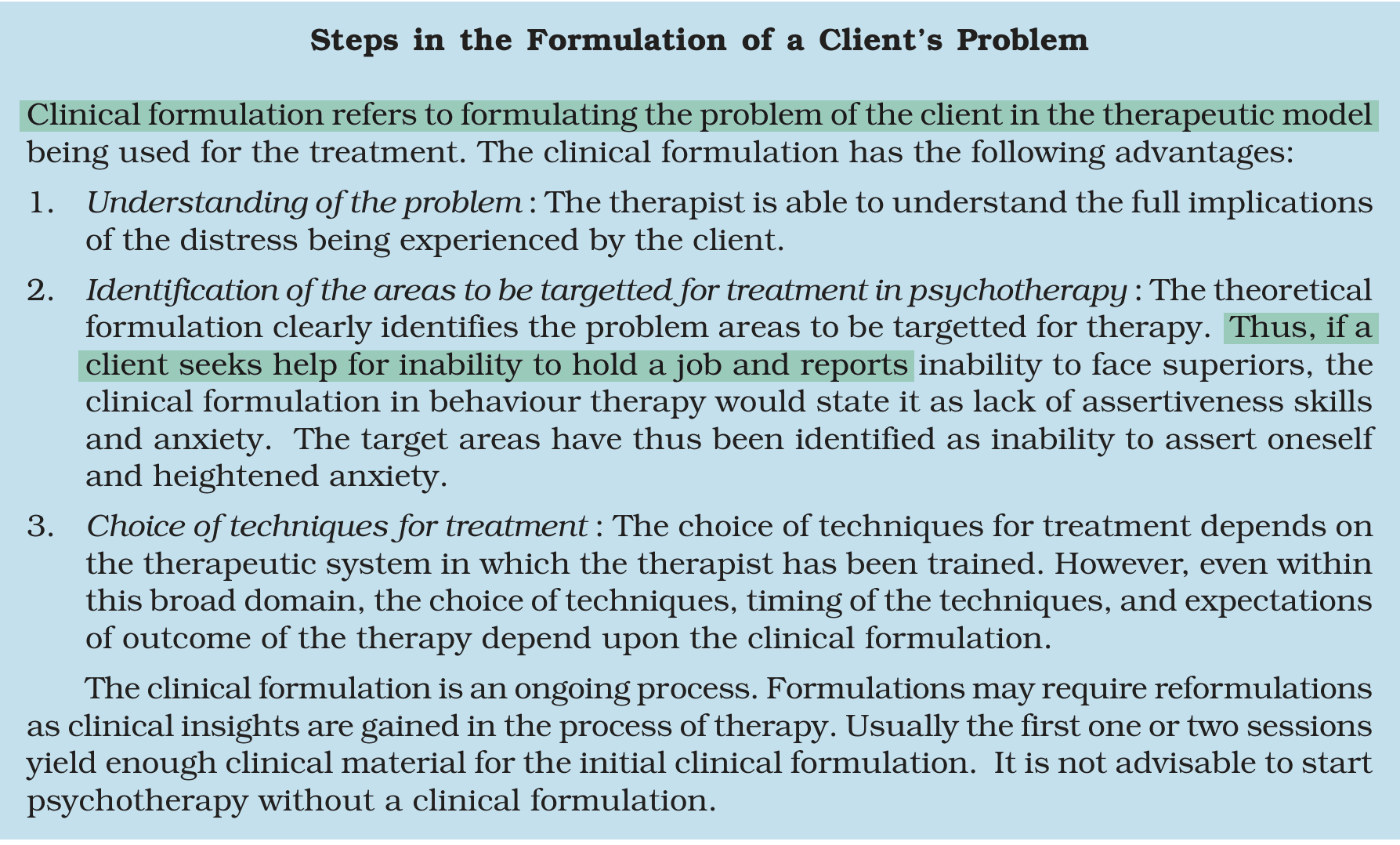
Sunita, a 30-year-old bank clerk in Lucknow, seeks help because she cannot speak up at meetings and feels intense anxiety before meeting her manager. In the first two sessions, her behaviour therapist interviews her and her family members and then states her problem as lack of assertiveness skills and heightened anxiety. On this basis, the therapist decides which techniques to use, when to use them and what outcome to expect. The therapist does not ask Sunita to relive her childhood; her past is discussed only to see how her difficulties began.
The therapist's act of stating Sunita's difficulty as lack of assertiveness skills and anxiety, within the model of behaviour therapy, is called:
Answer & explanation
Correct answer: option 2
The correct answer is Option (2) → Clinical formulation
| Option | Reason |
|---|---|
| Option (1): Behavioural analysis. Incorrect. | Behavioural analysis finds the malfunctioning behaviours, the antecedents of faulty learning and the factors that maintain it. |
| Option (2): Clinical formulation. Correct. | Clinical formulation means stating the client's problem in the therapeutic model being used. In behaviour therapy a person who cannot face superiors is formulated as lacking assertiveness skills and having anxiety. |
| Option (3): Clinical diagnosis. Incorrect. | A clinical diagnosis names the disorder the client has, and along with the symptoms it guides which techniques are selected. |
| Option (4): Establishing operation. Incorrect. | An establishing operation changes the reinforcing value of a consequence before the behaviour, such as a smaller snack at tea time. |
NCERT (2026-27):
|