What would be the major product when propene reacts with water in presence of acid catalyst?
Answer & explanation
Correct answer: option 1
The correct answer is Option (1) → propan-2-ol
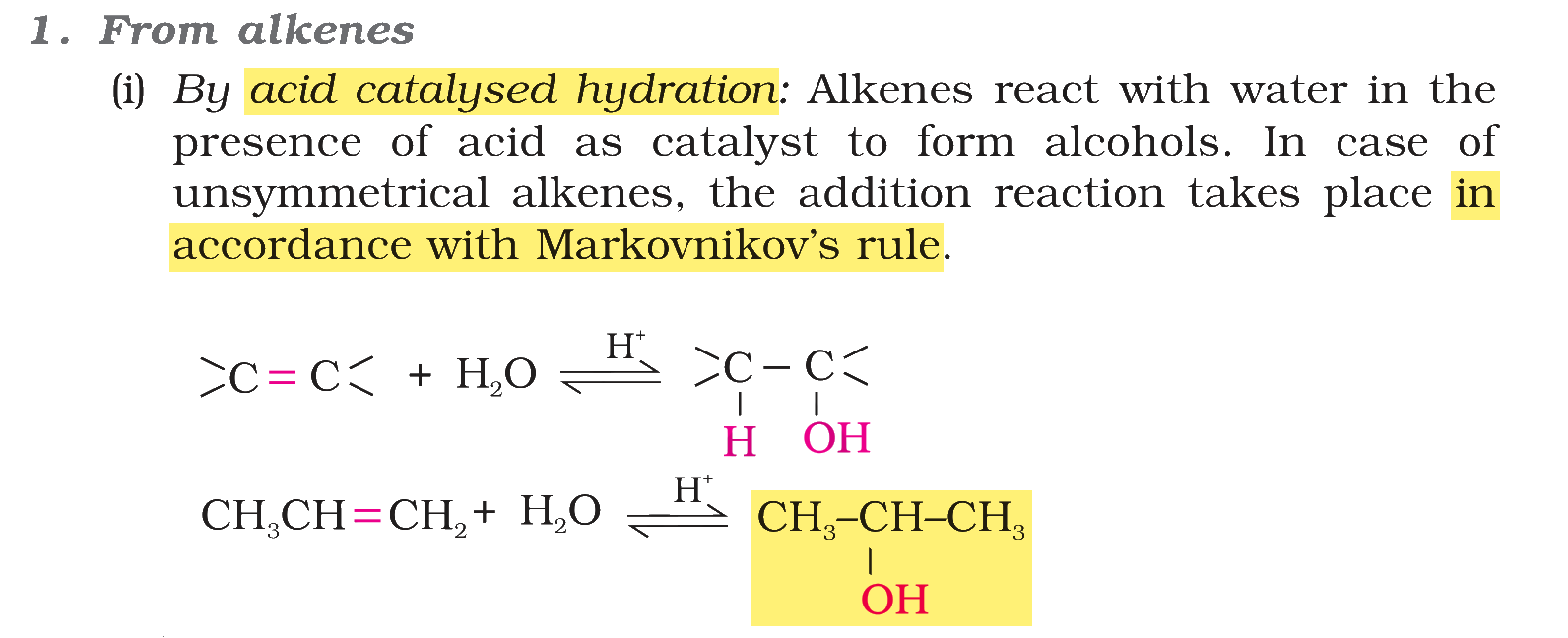
Alkenes react with water in the presence of an acid catalyst to give alcohols. This is acid catalysed hydration. For an unsymmetrical alkene the addition follows Markovnikov’s rule: the H goes to the double-bond carbon that already has more hydrogens, and the –OH goes to the other carbon.
The mechanism shows why. The reaction goes through a carbocation, and the more stable one is formed:
\( \displaystyle \ce{CH3-CH=CH2 + H3O^+ -> CH3-CH^+-CH3 + H2O} \)
\( \displaystyle \ce{CH3-CH^+-CH3 + H2O -> CH3-CH(OH2^+)-CH3} \)
\( \displaystyle \ce{CH3-CH(OH2^+)-CH3 + H2O -> CH3-CH(OH)-CH3 + H3O^+} \)
First, \( \ce{H3O^+} \) protonates the terminal \( \ce{CH2} \) carbon. This gives the secondary carbocation, which is stabilised by two alkyl groups and is more stable than the primary one. Water then attacks the positive carbon, and loss of a proton gives the alcohol.
So the major product is propan-2-ol, \( \ce{CH3-CH(OH)-CH3} \).
Why the other options are incorrect
Option (2) propan-1-ol — Incorrect. This is the anti-Markovnikov alcohol. It would need the primary carbocation, which is less stable. Propan-1-ol is made from propene by hydroboration–oxidation (\( \ce{B2H6} \), then \( \ce{H2O2/OH^-} \)), not by acid catalysed hydration.
Option (3) propane-1,2-diol — Incorrect. A diol has two –OH groups. Hydration adds only one H and one OH across the double bond; a 1,2-diol comes from oxidation with cold dilute alkaline \( \ce{KMnO4} \).
Option (4) butanoic acid — Incorrect. It has four carbon atoms and a –COOH group. Hydration adds no carbon and is not an oxidation, so propene cannot give it.
NCERT (2026-27 edition):
Preparation of Alcohols