
The figure shows an electric dipole of dipole moment \(\mathbf{p}\) in a uniform electric field \(\mathbf{E}\).
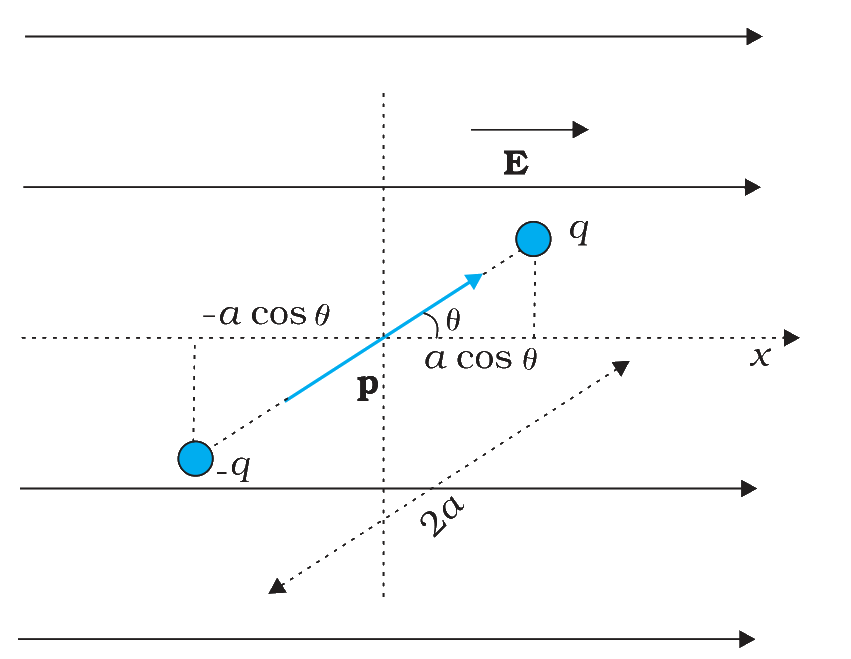
The angle \(\theta\) is slowly increased from the value shown to \(180^\circ\). Which of the following statements about the potential energy of the dipole is correct?
Answer & explanation
Correct answer: option 2
The correct answer is Option (2) → It increases steadily and becomes \(+pE\) at \(\theta=180^\circ\).
The potential energy of a dipole in a uniform field is \( U=-\mathbf{p}\cdot\mathbf{E} \), that is, \( U=-pE\cos\theta \). In the figure, \( \theta \) is an acute angle, so \( U \) starts with a negative value.
Option (1) It decreases steadily and becomes \(-pE\) at \(\theta=180^\circ\). — Incorrect. As \( \theta \) grows, \( \cos\theta \) falls. So \( -pE\cos\theta \) rises as the dipole turns.
Option (2) It increases steadily and becomes \(+pE\) at \(\theta=180^\circ\). — Correct. \( \cos\theta \) falls steadily from a positive value to \( -1 \). So \( U \) rises steadily and reaches \( -pE(-1)=+pE \) when the dipole points opposite to the field. This is the position of highest energy.
Option (3) It is the largest at \(\theta=90^\circ\) and then decreases. — Incorrect. At \( \theta=90^\circ \), \( U=0 \), and it keeps rising after that. The quantity that is largest at \( 90^\circ \) is the torque \( pE\sin\theta \).
Option (4) It does not change, because the net force on the dipole is zero. — Incorrect. The net force is zero in a uniform field, but the torque is not. Work is done against the torque in turning the dipole, so \( U \) changes with \( \theta \).
NCERT (2026-27):
Potential energy of a dipole in an external field – “… We can then associate potential energy U(θ) with an inclination θ of the dipole. … A natural choice is to take θ0 = π / 2. … We can then write,”
\( \displaystyle U(\theta)=pE\left(\cos\frac{\pi}{2}-\cos\theta\right)= \)…\( = \)\( -\mathbf{p}\cdot\mathbf{E} \)\( \qquad (2.32) \)
FIGURE 2.16 Potential energy of a dipole in a uniform external field.