
Select the correct statements regarding growth curves:
a) In the logistic growth equation, K stands for the intrinsic rate of natural increase.
b) Exponential growth results in a J-shaped curve when N is plotted against time.
c) The S-shaped (logistic) growth curve is considered more realistic.
d) In logistic growth, a lag phase is followed by phases of acceleration and deceleration.
Answer & explanation
Correct answer: option 3
The correct answer is Option (3) → b, c and d only
a) In the logistic growth equation, K stands for the intrinsic rate of natural increase. — False. In the equation, K is the carrying capacity, the largest population the habitat can support. The intrinsic rate of natural increase is r.
b) Exponential growth results in a J-shaped curve when N is plotted against time. — True. With unlimited resources, the population keeps multiplying at its full rate, and the curve of N against time rises steeply in a J shape.
c) The S-shaped (logistic) growth curve is considered more realistic. — True. Resources are finite and become limiting sooner or later, so real populations level off. The logistic (sigmoid) model is more realistic.
d) In logistic growth, a lag phase is followed by phases of acceleration and deceleration. — True. With limited resources, growth is slow at first (lag phase), then speeds up, then slows down, and finally reaches an asymptote at the carrying capacity.
NCERT Extract:
Population Growth – “… The above equation describes the exponential or geometric growth pattern of a population (Figure 11.3) and results in a J-shaped curve when we plot N in relation to time.”
Population Growth – “… A population growing in a habitat with limited resources show initially a lag phase, followed by phases of acceleration and deceleration and finally an asymptote, when the population density reaches the carrying capacity. A plot of N in relation to time (t) results in a sigmoid curve. This type of population growth is called Verhulst-Pearl Logistic Growth (Figure 11.3) and is described by the following equation:
\( \displaystyle\frac{dN}{dt} = rN\left(\frac{K-N}{K}\right) \)
Where N = Population density at time t
r = Intrinsic rate of natural increase
K = Carrying capacity
Since resources for growth for most animal populations are finite and become limiting sooner or later, the logistic growth model is considered a more realistic one.”
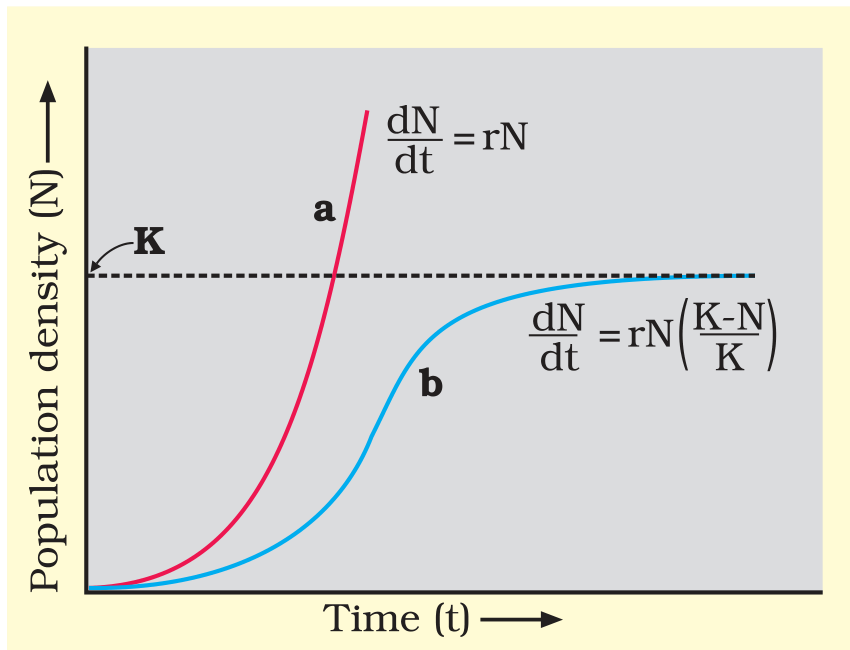
Figure 11.3 Population growth curve: a when responses are not limiting the growth, plot is exponential; b when responses are limiting the growth, plot is logistic; K is carrying capacity