
Arrange the following steps for working of a full wave rectifier in correct sequence.
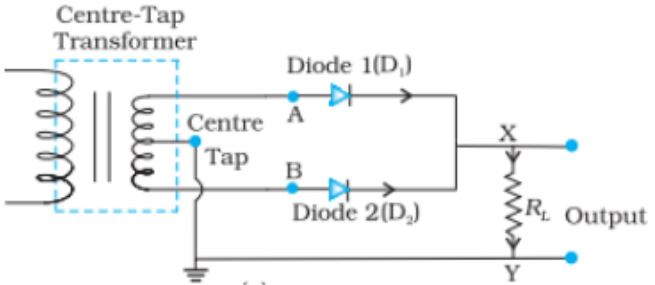
(A) During the negative half cycle, \( D_1 \) is reverse biased while \( D_2 \) is forward biased.
(B) During the positive half cycle, \( D_1 \) is forward biased while \( D_2 \) is reverse biased.
(C) A pulsating d.c. voltage is obtained across \( R_L \)
(D) a.c. input is given to the primary of a centre-tap transformer
Choose the correct answer from the options given below:
Answer & explanation
Correct answer: option 4
The correct answer is Option (4) → (D), (B), (A), (C)
In a centre-tap full wave rectifier the two diodes conduct in turn, one in each half cycle, and both send current through \( R_L \) in the same direction.
(D) First the a.c. input is applied to the primary of the centre-tap transformer, which produces the a.c. voltages at the two ends A and B of the secondary.
(B) In the positive half cycle, A is positive with respect to the centre tap, so \( D_1 \) is forward biased and conducts, while \( D_2 \) is reverse biased.
(A) In the negative half cycle, B becomes positive, so \( D_2 \) conducts and \( D_1 \) is reverse biased.
(C) Since the current through \( R_L \) flows from X to Y in both half cycles, the output across \( R_L \) is a pulsating d.c. voltage.
The order is D, B, A, C.
NCERT (2026-27):
Application of Junction Diode as a Rectifier – “… So for a full-wave rectifier the secondary of the transformer is provided with a centre tapping and so it is called centre-tap transformer.”
Application of Junction Diode as a Rectifier – “… So, diode D1 gets forward biased and conducts (while D2 being reverse biased is not conducting). … In this part of the cycle diode D1 would not conduct but diode D2 would, giving an output current and output voltage (across RL) during the negative half cycle of the input ac. … The rectified voltage is in the form of pulses of the shape of half sinusoids.”