
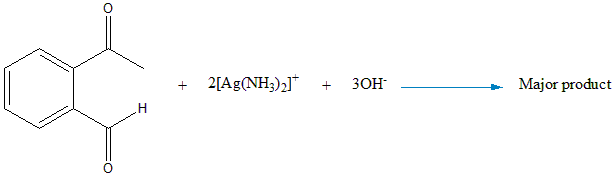
Identify the major product obtained in the following reaction:
Answer & explanation
Correct answer: option 1
The correct answer is Option (1) → the keto carboxylate (C=O kept, –CHO oxidised to –COO–)
Ammoniacal silver nitrate, \( \ce{[Ag(NH3)2]+} \) with \( \ce{OH-} \), is Tollens’ reagent, a mild oxidising agent. It oxidises an aldehyde group to the carboxylate anion and is itself reduced to a silver mirror. Ketones are oxidised only under vigorous conditions, so it does not attack the ketone group:
\( \displaystyle \ce{RCHO + 2[Ag(NH3)2]^+ + 3OH^- -> RCOO^- + 2Ag v + 2H2O + 4NH3} \)
So in 2-acetylbenzaldehyde only the –CHO group becomes –\( \ce{COO-} \), and the –\( \ce{COCH3} \) group stays as it is.
Option (2), the diol — Incorrect. Both carbonyl groups are shown reduced to alcohols. Tollens’ reagent is an oxidising agent; it does not reduce either group.
Option (3), the keto alcohol — Incorrect. The –CHO group is shown reduced to –\( \ce{CH2OH} \); Tollens’ reagent oxidises the aldehyde to –\( \ce{COO-} \).
Option (4), the hydroxy carboxylate — Incorrect. The –CHO group is oxidised correctly, but the ketone is shown reduced to a secondary alcohol; Tollens’ reagent leaves the ketone unchanged.
NCERT (2026-27 edition):
Oxidation – …

Oxidation – “… Ketones are generally oxidised under vigorous conditions, i.e., strong oxidising agents and at elevated temperatures.”