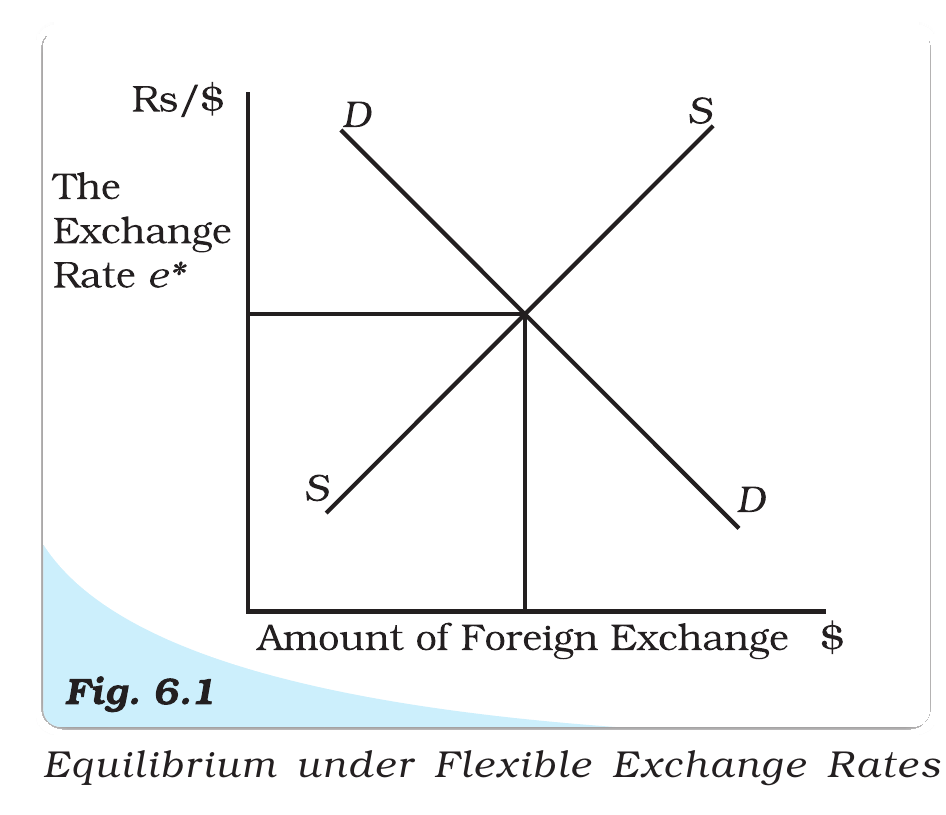
Arrange the steps involved in determining the exchange rate in the flexible exchange rate system :
(A) Determination of X-axis (amount of Foreign Exchange in $) and Y-axis (The Exchange Rate)
(B) Marking of Exchange Rate corresponding to the intersection
(C) Determination of Demand Curve & Supply Curve of Foreign Exchange
(D) Determination of the intersection point of Demand & Supply curve
(E) Exchange rate determined
Choose the correct answer from the options given below :
Answer & explanation
Correct answer: option 2
The correct answer is Option (2) → (A), (C), (D), (B), (E)
In a flexible system, the exchange rate is set by the market forces of demand and supply. The steps follow the way the diagram is drawn and read.
(A) Determination of X-axis (amount of Foreign Exchange in $) and Y-axis (The Exchange Rate) — the axes come first. The curves are drawn on them.
(C) Determination of Demand Curve & Supply Curve of Foreign Exchange — both curves are then drawn.
(D) Determination of the intersection point of Demand & Supply curve — the point where they cross is the equilibrium.
(B) Marking of Exchange Rate corresponding to the intersection — from that point, the rate is read on the Y-axis.
(E) Exchange rate determined — the rate so marked is the market rate.
NCERT (2026-27): “Flexible Exchange Rate This exchange rate is determined by the market forces of demand and supply. It is also known as Floating Exchange Rate. As depicted in Fig. 6.1, the exchange rate is determined where the demand curve intersects with the supply curve, i.e., at point e on the Y – axis. Point q on the x – axis determines the quantity of US Dollars that have been demanded and supplied on e exchange rate. In a completely flexible system, the Central banks do not intervene in the foreign exchange market.…”
|