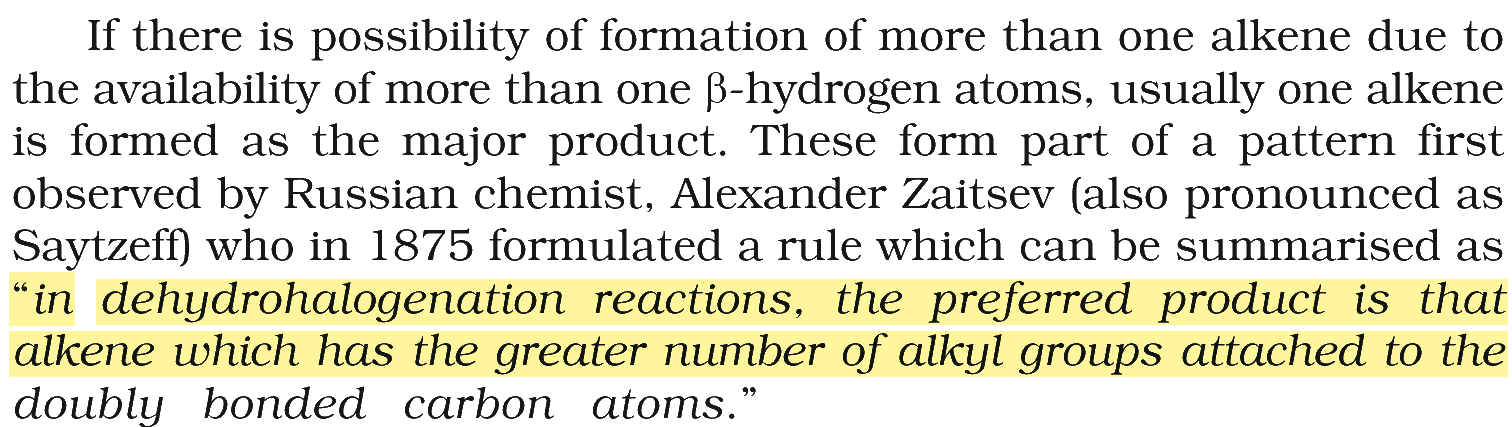
Identify A and B respectively in the following equation.
Answer & explanation
Correct answer: option 1
The correct answer is Option (1) → Methylenecyclopentane and 1-methylcyclopentene
A tertiary alkyl halide with a base undergoes β-elimination (dehydrohalogenation): the base removes a hydrogen from a β-carbon and Cl– leaves, giving an alkene. 1-Chloro-1-methylcyclopentane has two kinds of β-hydrogens: those on the \( \ce{CH3} \) group and those on the ring \( \ce{CH2} \) groups next to C1. The base decides which one is removed.
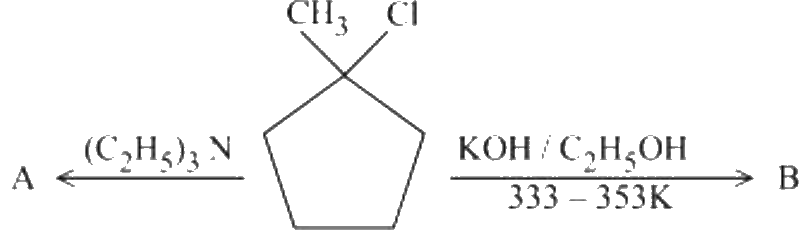
B (alcoholic KOH, 333–353 K): ethoxide/hydroxide is a small, strong base. It follows the Saytzeff (Zaitsev) rule: the major product is the more substituted alkene. Removing a ring hydrogen puts the double bond inside the ring, giving 1-methylcyclopentene (three alkyl groups on the C=C).
A (triethylamine): \( \ce{(C2H5)3N} \) is a bulky base. It cannot easily reach the ring hydrogens and takes a hydrogen from the more exposed \( \ce{CH3} \) group, so the double bond forms outside the ring: methylenecyclopentane, the less substituted (Hofmann-type) alkene.
1-chloro-1-methylcyclopentane \( \xrightarrow{\ce{(C2H5)3N}} \) methylenecyclopentane (A) + \( \ce{(C2H5)3NH+Cl-} \)
1-chloro-1-methylcyclopentane + KOH \( \xrightarrow[\text{333-353 K}]{\ce{C2H5OH}} \) 1-methylcyclopentene (B) + KCl + \( \ce{H2O} \)
So A is methylenecyclopentane and B is 1-methylcyclopentene, which is Option (1).
Why the other options are incorrect
Option (2) 1-methylcyclopentene and methylenecyclopentane — Incorrect. The same two alkenes in the reverse order; the small base (KOH) gives the more substituted ring alkene, so B cannot be methylenecyclopentane.
Option (3) cyclopentene and 1-methylcyclopentene — Incorrect. Cyclopentene has lost the methyl carbon; elimination removes only H and Cl, so every product keeps all six carbon atoms.
Option (4) cyclopentene and methylenecyclopentane — Incorrect. It also contains cyclopentene, which cannot form for the same reason, and puts the ring alkene with the bulky base.
Note: The question is from beyond the NCERT textbook.
NCERT (2026-27 edition):
Elimination Reactions – …