The Chipko movement in Uttarakhand region is indicative that India views environment from _____ perspective.
Answer & explanation
Correct answer: option 2
The correct answer is Option (2) → Spiritual
The psychologist Stokols described three perspectives on the human-environment relationship: minimalist, instrumental and spiritual.
Option (1) Minimalist — Incorrect. The minimalist perspective assumes that the physical environment has minimal or negligible influence on human behaviour, health and well-being. The Chipko villagers saw the forest as necessary to their lives.
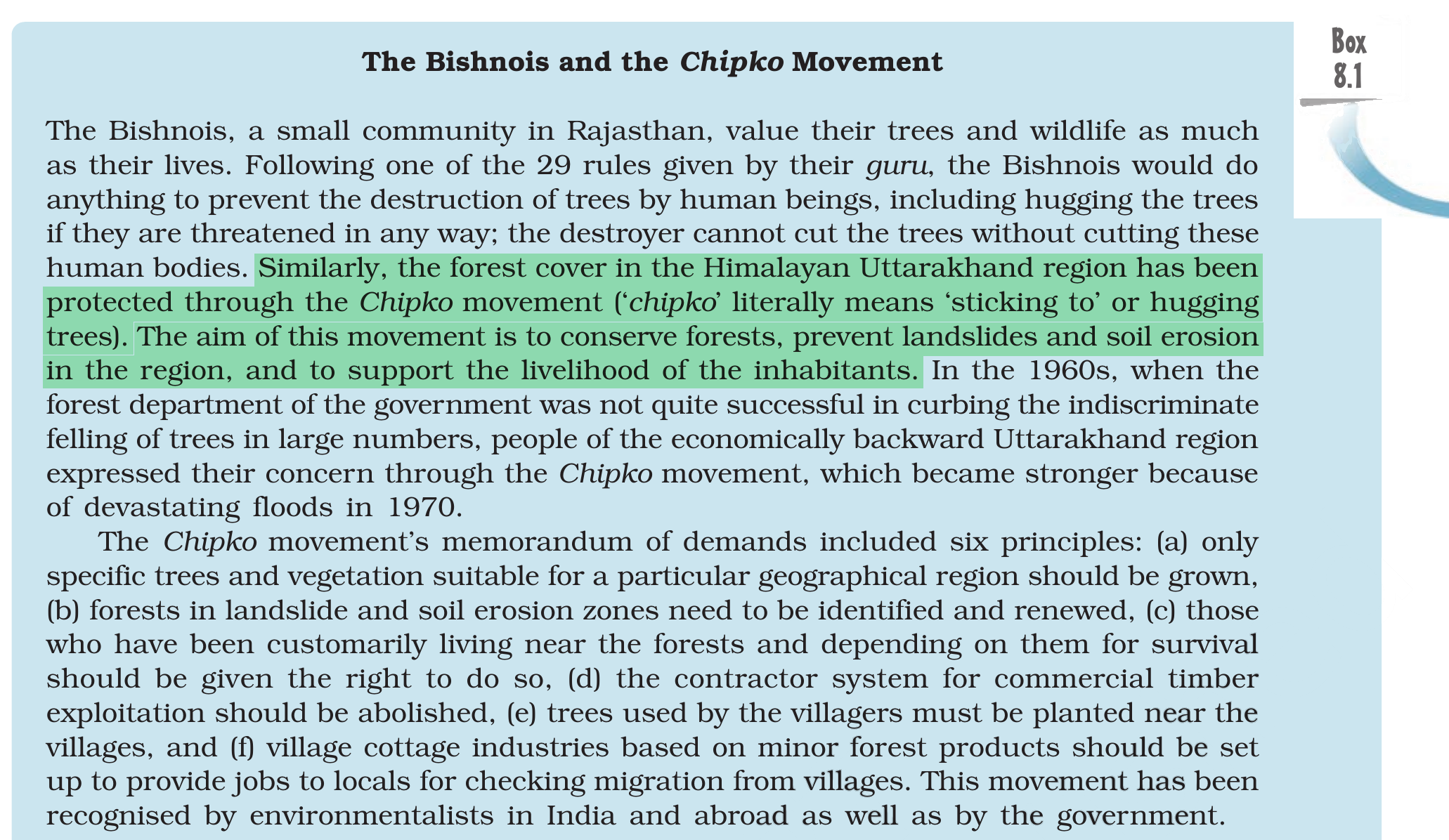
Option (2) Spiritual — Correct. The spiritual perspective views the environment as something to be respected and valued rather than exploited, and recognises that human beings will be happy only as long as the environment is kept healthy. The traditional Indian view supports it, and the Chipko movement in the Uttarakhand region is one of the two examples of it, with the customs of the Bishnois of Rajasthan.
Option (3) Instrumental — Incorrect. The instrumental perspective holds that the environment exists mainly for use by human beings for their comfort. Hugging trees to stop them being cut down is the opposite of treating the forest as a resource to use up.
Option (4) Man-Built — Incorrect. ‘Man-built’ is not a perspective on the human-environment relationship. ‘Built environment’ is a kind of environment, the one created by human beings, such as cities and dams; it is not a way of viewing the environment.
Note: Stokols’ three perspectives on the human-environment relationship, with the Chipko movement as an example of the spiritual perspective, were there in the pre-rationalised NCERT, which NTA followed in 2023, and are not there in the NCERT book (2025-26).
NCERT (Pre-rationalised): “…A psychologist named Stokols (1990) describes three approaches that may be adopted to describe the human-environment relationship.
Box 8.1: The Bishnois and the Chipko Movement (Pre-rationalised) |