
Read the paragraph and answer the Question given below:
There is no natural habitat on earth known that is inhabited just by a single species. For any species, the minimal requirement is one more species on which it can feed. Even a plant species, which makes its own food, cannot survive alone and needs soil microbes to break down the organic matter in soil and return the inorganic nutrients for absorption. It is obvious that in nature, animals, plants and microbes do not and cannot live in isolation but interact in various ways to form a biological community.
Which of the following is not associated with realistic growth model?
Answer & explanation
Correct answer: option 2
The correct answer is Option (2) → J-shaped growth curve
Option (1) Sigmoid shaped growth curve — Associated with the realistic growth model. The logistic model gives an S-shaped (sigmoid) curve: lag phase, acceleration, deceleration and an asymptote at the carrying capacity.
Option (2) J-shaped growth curve — Not associated with the realistic growth model. The J-shaped curve belongs to exponential growth, \( dN/dt = rN \), which happens only when resources are unlimited. No population in nature has unlimited resources, so this model is not the realistic one.
Option (3) Verhulst - Pearl logistic growth — Associated with the realistic growth model. This is the name of the logistic growth model, after the scientists who described it.
Option (4) Logistic Growth — Associated with the realistic growth model. Logistic growth takes the carrying capacity (K) into account.
Note: The passage is taken from NCERT. NTA has put lines of the NCERT text together to make it. Most CUET (UG) questions come straight from NCERT, so study the book line by line, including figures and their titles.
NCERT Extract:
Population Growth – “… In nature, a given habitat has enough resources to support a maximum possible number, beyond which no further growth is possible. Let us call this limit as nature’s carrying capacity (K) for that species in that habitat. A population growing in a habitat with limited resources show initially a lag phase, followed by phases of acceleration and deceleration and finally an asymptote, when the population density reaches the carrying capacity. A plot of N in relation to time (t) results in a sigmoid curve. This type of population growth is called Verhulst-Pearl Logistic Growth (Figure 11.3) and is described by the following equation:
\( \displaystyle \frac{dN}{dt} = rN\left(\frac{K-N}{K}\right) \)
Where
N = Population density at time t
r = Intrinsic rate of natural increase
K = Carrying capacity
Since resources for growth for most animal populations are finite and become limiting sooner or later, the logistic growth model is considered a more realistic one.”
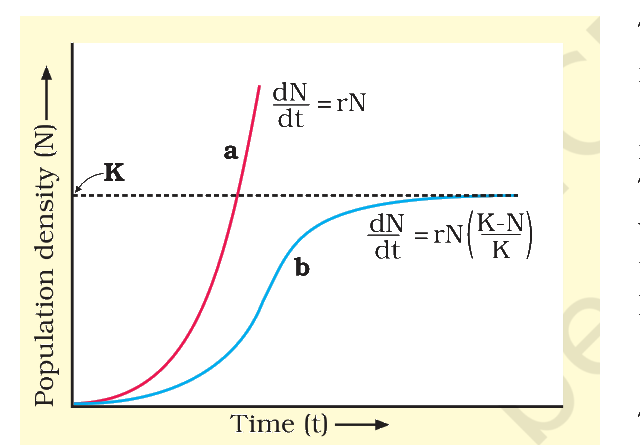
Figure 11.3 Population growth curve a when responses are not limiting the growth, plot is exponential, b when responses are limiting the growth, plot is logistic, K is carrying capacity