
Which one is the correct example of hermaphrodites?
Answer & explanation
Correct answer: option 1
The correct answer is Option (1) → Tapeworm and leech
A hermaphrodite is an animal that has both male and female reproductive organs in the same body. An animal with only one kind of reproductive organ is unisexual: each individual is either a male or a female.
Option (1) Tapeworm and leech — Correct. Both are bisexual animals, and the book names both as hermaphrodites.
Option (2) Cockroach and frog — Incorrect. The cockroach is the book’s example of a unisexual species. A frog is also either male or female, so neither animal is a hermaphrodite.
Option (3) Cockroach and earthworm — Incorrect. The earthworm is a hermaphrodite, but the cockroach is not. Only one of the pair fits, so the pair as a whole is wrong.
Option (4) Carp fish and pigeon — Incorrect. Fish and birds such as these have separate male and female individuals. They are unisexual.
Note: This question is from Chapter 1, Reproduction in Organisms, of the pre-rationalised NCERT book. This chapter is not in the present NCERT book (2026-27). The extract below is from the pre-rationalised edition.
NCERT Extract (Pre-rationalised edition, Chapter 1, Reproduction in Organisms):
Gametogenesis – “… You probably can make a list of several unisexual animal species. Earthworms, (Figure 1.6a) sponge, tapeworm and leech, typical examples of bisexual animals that possess both male and female reproductive organs, are hermaphrodites. Cockroach (Figure 1.6b) is an example of a unisexual species.”
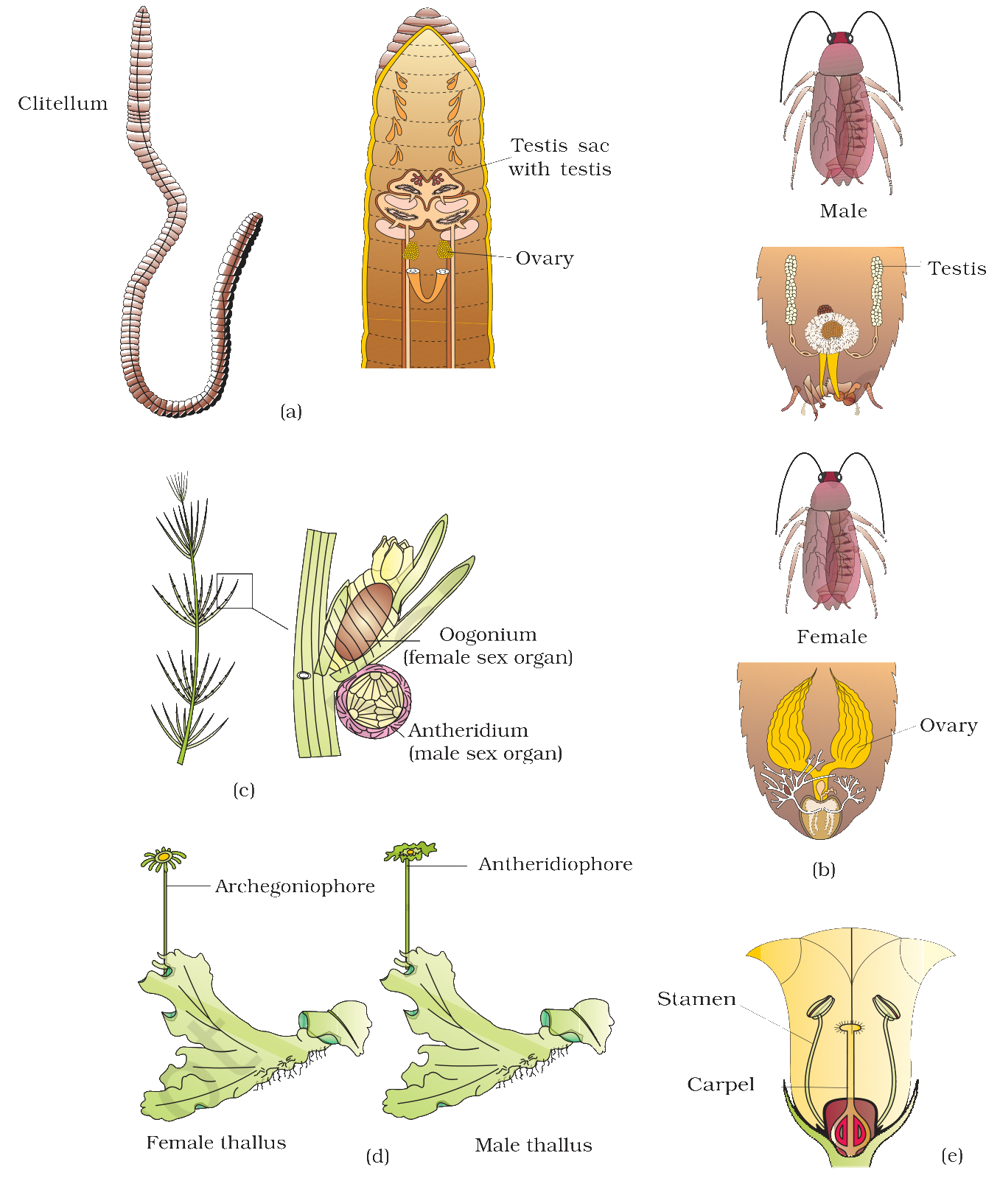
Figure 1.6 Diversity of sexuality in organisms (a) Bisexual animal (Earthworm); (b) Unisexual animal (Cockroach); (c) Monoecious plant (Chara); (d) Dioecious plant (Marchantia); (e) Bisexual flower (sweet potato)