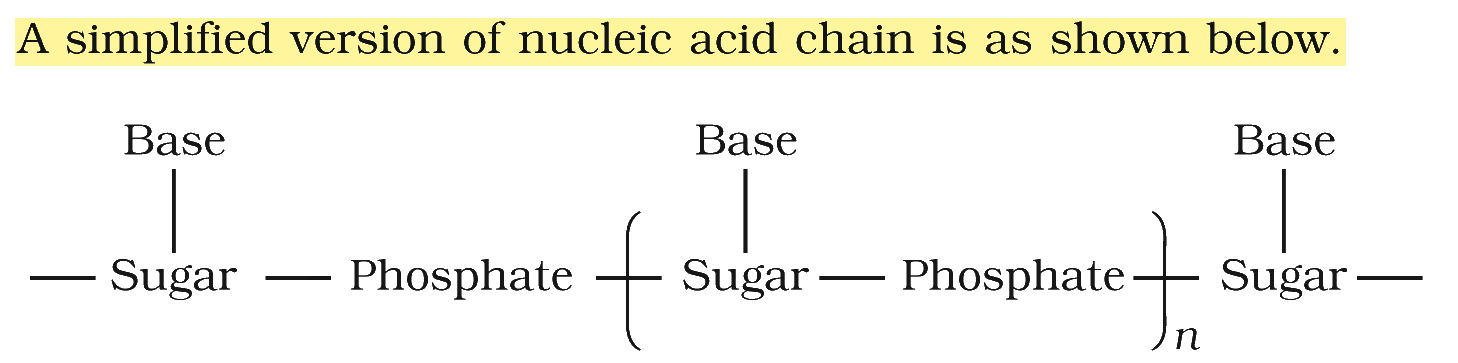
Which of the following is the correct sequence of a nucleic acid chain?
Answer & explanation
Correct answer: option 1
The correct answer is Option (1) → Sugar–phosphate chain with a base on every sugar
Nucleic acids are long chain polymers of nucleotides. Each nucleotide has three parts:
A nitrogenous base, attached to C-1′ of the sugar (base + sugar = nucleoside).
A pentose sugar: β-D-2-deoxyribose in DNA, β-D-ribose in RNA.
A phosphoric acid unit, esterified at C-5′ of the sugar (nucleoside + phosphate = nucleotide).
Nucleotides are joined by phosphodiester linkages between C-5′ of one sugar and C-3′ of the next. So the backbone of the chain is an alternating sequence of sugar and phosphate, and every sugar carries one base as a side group.
Only Option (1) shows this sequence, with a base on every sugar and sugars joined only through phosphate.
Why the other options are incorrect
Option (2) chain with a base inside the backbone — Incorrect. A base is placed inside the chain between two sugars and a phosphate is shown as a side group. Bases are never part of the backbone.
Option (3) chain whose last sugar has no base — Incorrect. The backbone is correct, but the last sugar has no base. Every sugar of a nucleic acid carries a base.
Option (4) chain with sugars joined directly — Incorrect. A base is placed in the chain, a phosphate is a side group, and the repeating sugars are joined to each other without phosphate.
NCERT (2026-27 edition):
Structure of Nucleic Acids – …