
CUETMOCK
  • Pricing
  • Mentors
Log inStart freeStart free mocks→

First test, then trust

Try a free CUET mock test.

Join 5,00,000+ students who rehearsed exam day on the exact NTA screen before sitting CUET. On the web and on Android.

Start free mocks →Get the Android app
CUETMOCK

India's #1 CUET Mock Test Platform. Original NCERT-based questions on the exact NTA exam screen — trusted by 5,00,000+ students since CUET 2022.

Get it onGoogle PlayScan to download the CUETMOCK app

Mock tests

  • CUET mock test series
  • Commerce mocks
  • Humanities (Arts) mocks
  • Science mocks
  • Languages & GAT mocks
  • Free practice questions
  • Pricing

Resources

  • CUET exam guide
  • CUET syllabus
  • Universities accepting CUET
  • Expert blogs
  • News & notifications
  • Webinars & counselling
  • CUET score calculator
  • How we estimate your rank
  • FAQs

Company

  • About us
  • Our leadership & team
  • Our toppers
  • Mentors
  • For schools
  • Contact us
  • Terms
  • Privacy
  • Refund policy

Talk to us

+91 7696 6630 56info@cuetmock.comWhatsApp us

Our other platforms

  • JEE Mock — For IIT-JEE aspirants
  • NEET Mock — For NEET aspirants

Newsletter

Exam updates, study material and offers — no spam.

© 2026 NYC Ventures Pvt. Ltd.

701-702, Royal Business Park, Zirakpur, Punjab - 140603

  • Terms of use
  • Privacy policy
  • Refund policy
  • Contact us

iCUETMOCK is an independent preparation platform, not affiliated with the National Testing Agency (NTA). Always check exam details on the official NTA website.

  • Home
  • Mock tests
  • CUET guide
  • Pricing
  • Log in
Home/Practice questions/Biology
BiologyOrganisms and Populations

A tiny Paramecium starts with just one individual and, through binary…

A tiny Paramecium starts with just one individual and, through binary fission, doubles in numbers every day. Food and space are taken to remain unlimited.

Which of the following describes the growth of this population?

Answer & explanation+

Correct answer: option 2

The correct answer is Option (2) → dN/dt = rN, giving a J-shaped curve when N is plotted against time

The case says that food and space remain unlimited. When resources are unlimited, a species can fully use its innate potential to grow in number, and the population grows in an exponential or geometric fashion. This growth is written as dN/dt = rN, where r is the intrinsic rate of natural increase. Plotting N against time gives a J-shaped curve. The equation with the term (K − N)/K is used only when resources are limited and a carrying capacity (K) exists.

Option (1) dN/dt = rN [(K − N)/K], giving a sigmoid curve when N is plotted against time — Incorrect. This pair is correct for logistic (Verhulst-Pearl) growth, which happens when resources are limited. Here food and space are unlimited, so there is no carrying capacity to slow the growth.

Option (2) dN/dt = rN, giving a J-shaped curve when N is plotted against time — Correct. Unlimited resources give exponential growth. Its equation is dN/dt = rN, and the plot of N against time is J-shaped.

Option (3) dN/dt = rN [(K − N)/K], giving a J-shaped curve when N is plotted against time — Incorrect. This mixes the two models. The logistic equation gives a sigmoid curve, not a J-shaped one, and it does not fit unlimited food and space.

Option (4) dN/dt = rN, giving a sigmoid curve when N is plotted against time — Incorrect. The equation is right but the curve is wrong. dN/dt = rN gives a J-shaped curve; the sigmoid curve belongs to logistic growth.

NCERT Extract:
Growth Models – “… Ideally, when resources in the habitat are unlimited, each species has the ability to realise fully its innate potential to grow in number, as Darwin observed while developing his theory of natural selection. Then the population grows in an exponential or geometric fashion.”
Growth Models – “… Let (b–d) = r, then dN/dt = rN … The above equation describes the exponential or geometric growth pattern of a population (Figure 11.3) and results in a J-shaped curve when we plot N in relation to time.”
Growth Models – “… Now think of a tiny Paramecium starting with just one individual and through binary fission, doubling in numbers every day, and imagine what a mind-boggling population size it would reach in 64 days. (provided food and space remain unlimited)”
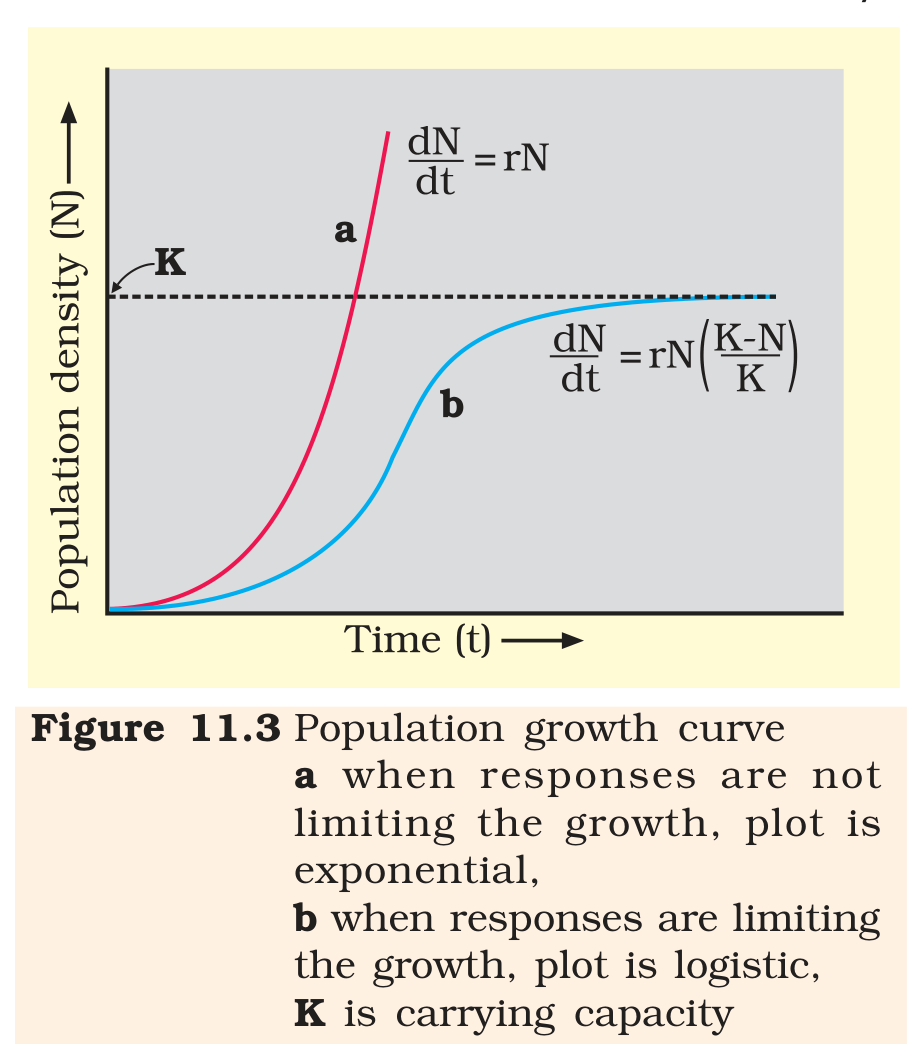
Textbook figure

Figure 11.3 Population growth curve: a, exponential (dN/dt = rN); b, logistic

Advertisement

Practise more on Organisms and Populations

Chapter-wise mocks on the real NTA exam screen, with solutions and your rank. Your first mocks are free.

Start free mocks →

Advertisement

Next questions

  1. Which of the following pairs of words carries the same relationship as:FLURRY : BLIZZARDEnglish · Analogy
  2. What is the EAN of Pt in potassium hexachloroplatinate?Chemistry · Inorganic: Coordination Compounds
  3. Match List I with List II LIST I LIST II A. Buna-S I. Polyamide B. Nylon 6, 6 II. Homopolymer C. Polythene III. Terephthalic acid, ethylene…Chemistry · Organic: Polymers
  4. From the positions of a cube are shown below, Which letter will be on the face opposite to face with 'A'?General Aptitude Test · Verbal Reasoning
  5. Which of the following is a tangible asset?Business Studies · Financial Management
  6. In electromagnetic waves in free space, the RMS value of magnetic field is 5 T. What is the peak value of the same?Physics · Electromagnetic Waves
  7. The intermediate castes become the dominant caste in the countryside as a result of: (A) Land reforms that took away rights from absentee l…Sociology · Indian Society: Continuity and Change
  8. International Trade is mutually beneficial as no country is self-sufficient. India’s international trade has undergone a sea change in rece…Geography · India-People and Economy: International Trade
  9. Select the most appropriate meaning of the given idiom. To fish in troubled watersEnglish · Grammar: Idioms
  10. Who coined the term 'Rajput Paintings' in 1916?Fine Arts · The Rajasthani Schools of Painting