
Read the following passage and answer the questions.
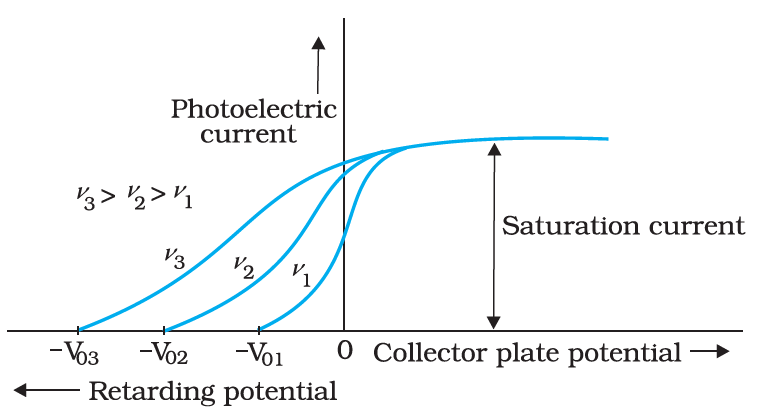
A student uses a photocell to study how the stopping potential \(V_0\) depends on the frequency \(\nu\) of the incident light. She uses one source of light and puts a different filter in front of it for each frequency. The source stays at the same distance from the cell in every run. For each frequency, she records the photocurrent while she changes the potential of the collector plate. Figure (a) shows her results for three frequencies \(\nu_1\), \(\nu_2\) and \(\nu_3\). Each curve meets the potential axis at a different negative potential.
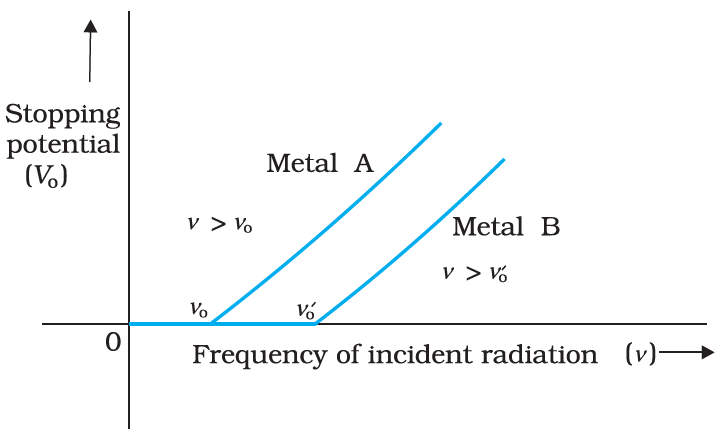
She then repeats the work with emitters of two different metals, A and B. For each metal she plots the stopping potential against the frequency and gets a straight line, as in figure (b). The line for metal A starts at the cut-off frequency \(\nu_0\), and the line for metal B starts at \(\nu_0^{\prime}\). In her experiment, \(\nu_0 = 5.0\times10^{14}\ \mathrm{Hz}\) and \(\nu_0^{\prime} = 8.0\times10^{14}\ \mathrm{Hz}\).
(a)
(b)
What is the relation between the maximum kinetic energy \( K_{\mathrm{max}} \) of the photoelectrons and the stopping potential \( V_0 \)?
Answer & explanation
Correct answer: option 2
The correct answer is Option (2) → \( K_{\mathrm{max}}=eV_0 \)
The stopping potential \( V_0 \) is the retarding potential that just stops the most energetic photoelectrons.
Option (1) \( K_{\mathrm{max}}=V_0/e \) — Incorrect. Energy is charge times potential difference. \( V_0/e \) has the unit V/C, which is not a unit of energy.
Option (2) \( K_{\mathrm{max}}=eV_0 \) — Correct. An electron moving against a potential difference \( V_0 \) loses energy \( eV_0 \). The fastest electrons just come to rest, so their kinetic energy is \( eV_0 \).
Option (3) \( K_{\mathrm{max}}=\sqrt{eV_0} \) — Incorrect. The energy lost grows in direct proportion to \( V_0 \). \( \sqrt{eV_0} \) has the unit \( \mathrm{J^{1/2}} \), which is not a unit of energy.
NCERT (2026-27):
Effect of Potential on Photoelectric Current – “… Photoelectric current is zero when the stopping potential is sufficient to repel even the most energetic photoelectrons, with the maximum kinetic energy (Kmax), so that”
\( K_{\mathrm{max}}=e\,V_0 \)\( \qquad (11.1) \)