Match the LIST-I with LIST-II:
| LIST-I Associations | LIST-II Term/Name/Place | ||
| A. | The study of DNA of ancient population | I. | Mohenjodaro |
| B. | The first Director-General of the ASI | II. | Shamans |
| C. | The stone statue of ‘Priest-king’ | III. | Alexander Cunningham |
| D. | Men and women who claim magical and healing powers | IV. | Archaeogenetics |
Choose the correct answer from the options given below:
Answer & explanation
Correct answer: option 3
The correct answer is Option (3) → A - IV, B - III, C - I, D - II
(A) The study of DNA of ancient population — this matches (IV) Archaeogenetics. Archaeogenetics uses the methods of molecular genetics on ancient DNA to understand the history of populations.
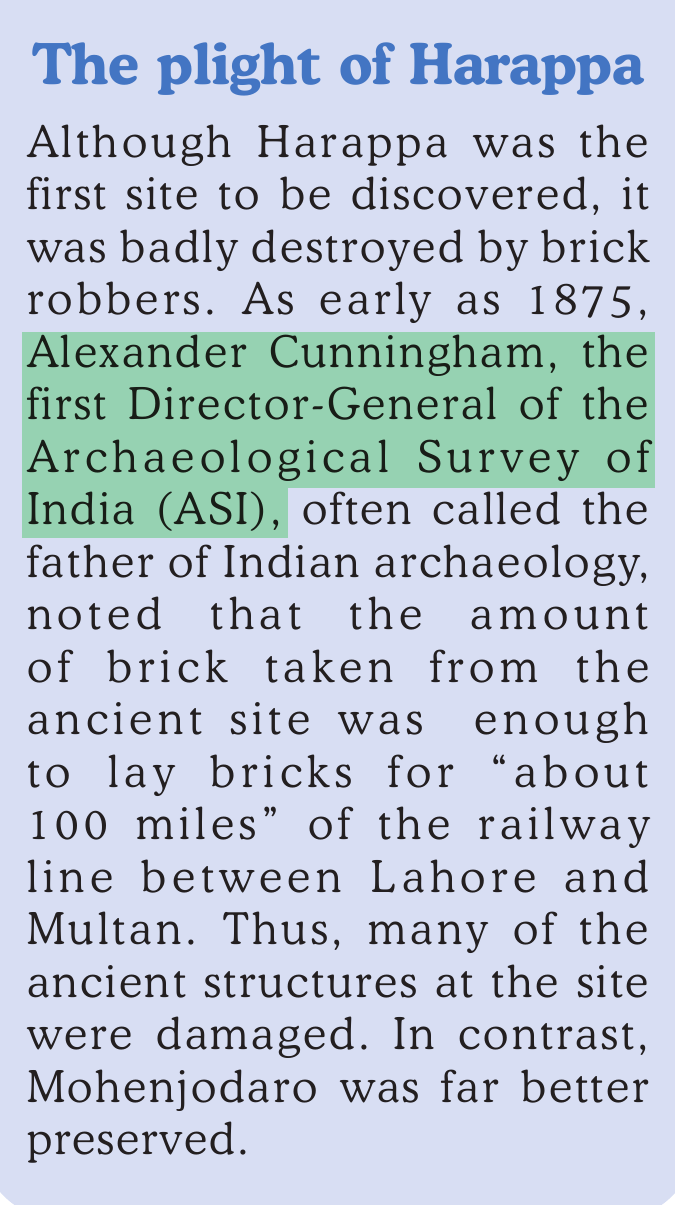
(B) The first Director-General of the ASI — this matches (III) Alexander Cunningham. He is often called the father of Indian archaeology. As early as 1875 he noted how much brick had been taken from Harappa for the railway line between Lahore and Multan.
(C) The stone statue of ‘Priest-king’ — this matches (I) Mohenjodaro. A large building at Mohenjodaro was labelled a palace, and a stone statue found there is still known as the “priest-king”. The name came from Mesopotamia, whose history had “priest-kings”; whether the Harappans had such rulers is not known.
(D) Men and women who claim magical and healing powers — this matches (II) Shamans. Shamans claim magical and healing powers and an ability to communicate with the other world. Some scholars think the seated figure on the so-called “proto-Shiva” seal may be a shaman.
NCERT (2025-26): “8.1 Palaces and kings … A large building found at Mohenjodaro was labelled as a palace by archaeologists but no spectacular finds were associated with it. A stone statue was labelled and continues to be known as the ‘priest-king’. This is because archaeologists were familiar with Mesopotamian history and its ‘priest-kings’ and have found parallels in the Indus region.… 10.1 Cunningham’s confusion … Archaeogenetics is the study of DNA of ancient population. It involves various methods of molecular genetics to understand population history. 11.2 Problems of interpretation … Shamans are men and women who claim magical and healing powers, as well as an ability to communicate with the other world.”
|