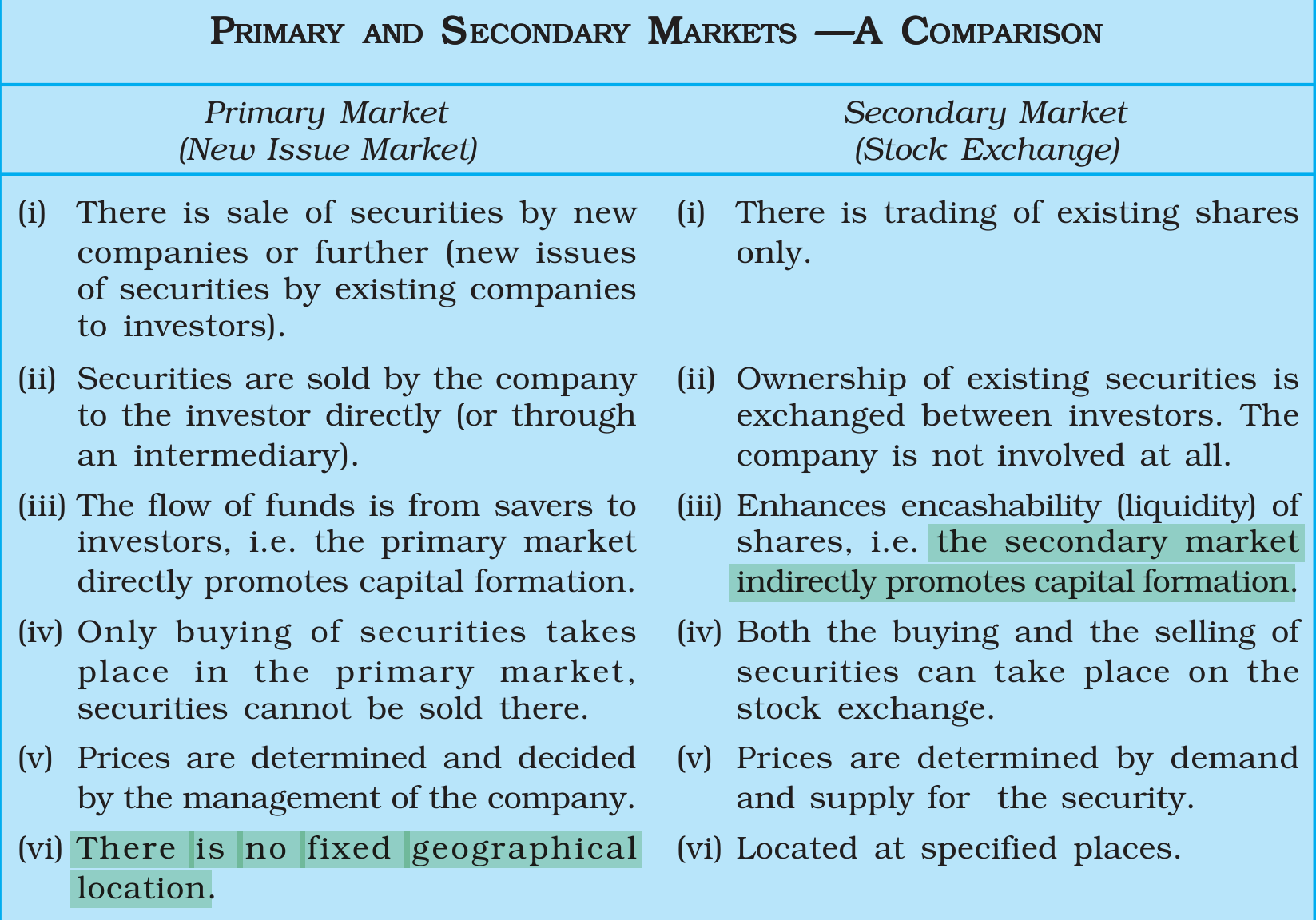
Consider the following statements about the primary and secondary markets:
(A) In the primary market, securities are sold by the company to the investor directly or through an intermediary.
(B) The secondary market directly promotes capital formation.
(C) The secondary market enhances the encashability (liquidity) of shares.
(D) The primary market is located at specified places.
(E) In the secondary market, ownership of existing securities is exchanged between investors.
Choose the incorrect statements from the above.
Choose the correct answer from the options given below:
Answer & explanation
Correct answer: option 1
The correct answer is Option (1) → (B) and (D) only
(A) In the primary market, securities are sold by the company to the investor directly or through an intermediary. — True. The company sells new securities to investors, directly or through an intermediary.
(B) The secondary market directly promotes capital formation. — False. The secondary market improves the encashability (liquidity) of shares. So it promotes capital formation only indirectly.
(C) The secondary market enhances the encashability (liquidity) of shares. — True. Investors can sell shares easily on the stock exchange, so their shares become easy to encash.
(D) The primary market is located at specified places. — False. The primary market has no fixed geographical location. Stock exchanges are the ones located at specified places.
(E) In the secondary market, ownership of existing securities is exchanged between investors. — True. Investors trade existing securities among themselves, and the company is not involved.
NCERT (Pre-rationalised Edition):
|